


Page 144 - Science at the nanoscale
P. 144
8:11
                                                     RPS: PSP0007 - Science-at-Nanoscale
                   June 9, 2009
                              Low-Dimensional Nanostructures
                         134
                                   facets of the growing nanocrystals. Such tunability of the shape
                                   and band-gap is very attractive for applications in nanocrystal-
                                   based solar cells.
                                          Quantum wires
                                   6.3.2
                                   Surface melting assisted oxidisation can be used to directly grow
                                   metal oxide nanostructures without the presence of solution or
                                   vapour. Here, we shall detail the commonly used vapour based
                                   method and introduce a simple and straightforward thermal
                                   heating technique for the growth of 1D nanowires.
                                     The vapour-based route is a widely adopted approach for the
                                   fabrication of metal oxide nanostructures.
                                   vapour can be achieved in many ways including simple thermal
                                   evaporation, laser ablation, sputtering, arc discharge, etc. Typical-
                                   ly, the precursor vapour is transported by a gas flow from source
                                   to the deposition substrate at a certain temperature range. The
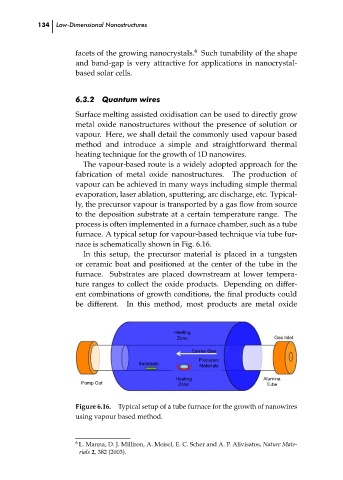
                                   process is often implemented in a furnace chamber, such as a tube
                                   furnace. A typical setup for vapour-based technique via tube fur-
                                   nace is schematically shown in Fig. 6.16.
                                     In this setup, the precursor material is placed in a tungsten
                                   or ceramic boat and positioned at the center of the tube in the
                                   furnace. Substrates are placed downstream at lower tempera-
                                   ture ranges to collect the oxide products. Depending on differ-
                                   ent combinations of growth conditions, the final products could
                                   be different.
                                                In this method, most products are metal oxide
                                                             Heating  6     The production of      ch06
                                                             Zone                      Gas Inlet
                                                                 Carrier Gas
                                                                   Precursor
                                                   Substrate
                                                                   Materials
                                                             Heating                Alumina
                                     Pump Out                  Zone                  Tube
                                   Figure 6.16.  Typical setup of a tube furnace for the growth of nanowires
                                   using vapour based method.
                                   6  L. Manna, D. J. Milliron, A. Meisel, E. C. Scher and A. P. Alivisatos, Nature Mate-
                                    rials 2, 382 (2003).

