


Page 139 - Science at the nanoscale
P. 139
RPS: PSP0007 - Science-at-Nanoscale
                             8:11
                   June 9, 2009
                                               6.2. Electron Transport Properties in Low Dimensional Systems
                                                                     Drain
                                               Source
                                                           QD
                                                      Gate
                                  V
                                   sd
                                                            V g
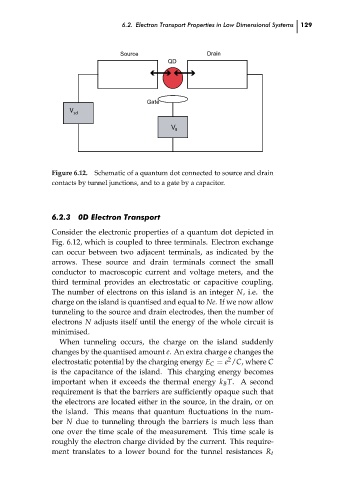
                                        Schematic of a quantum dot connected to source and drain
                             Figure 6.12.
                             contacts by tunnel junctions, and to a gate by a capacitor.
                                    0D Electron Transport
                             6.2.3
                             Consider the electronic properties of a quantum dot depicted in
                             Fig. 6.12, which is coupled to three terminals. Electron exchange
                             can occur between two adjacent terminals, as indicated by the
                             arrows. These source and drain terminals connect the small
                             conductor to macroscopic current and voltage meters, and the
                             third terminal provides an electrostatic or capacitive coupling.
                             The number of electrons on this island is an integer N, i.e. the
                             charge on the island is quantised and equal to Ne. If we now allow
                             tunneling to the source and drain electrodes, then the number of
                             electrons N adjusts itself until the energy of the whole circuit is
                             minimised.
                               When tunneling occurs, the charge on the island suddenly      129   ch06
                             changes by the quantised amount e. An extra charge e changes the
                                                                           2
                             electrostatic potential by the charging energy E C = e /C, where C
                             is the capacitance of the island. This charging energy becomes
                             important when it exceeds the thermal energy k B T. A second
                             requirement is that the barriers are sufficiently opaque such that
                             the electrons are located either in the source, in the drain, or on
                             the island. This means that quantum fluctuations in the num-
                             ber N due to tunneling through the barriers is much less than
                             one over the time scale of the measurement. This time scale is
                             roughly the electron charge divided by the current. This require-
                             ment translates to a lower bound for the tunnel resistances R t

