


Page 138 - Science at the nanoscale
P. 138
8:11
                                                     RPS: PSP0007 - Science-at-Nanoscale
                   June 9, 2009
                              Low-Dimensional Nanostructures
                         128
                                                              M, T
                                                          1D ballistic conductor
                                                 Contact
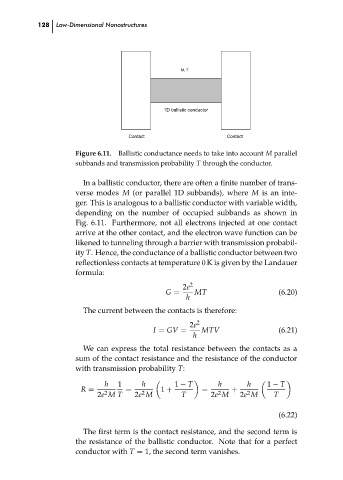
                                              Ballistic conductance needs to take into account M parallel
                                   Figure 6.11.
                                   subbands and transmission probability T through the conductor.
                                     In a ballistic conductor, there are often a finite number of trans-
                                   verse modes M (or parallel 1D subbands), where M is an inte-
                                   ger. This is analogous to a ballistic conductor with variable width,
                                   depending on the number of occupied subbands as shown in
                                   Fig. 6.11. Furthermore, not all electrons injected at one contact
                                   arrive at the other contact, and the electron wave function can be
                                   likened to tunneling through a barrier with transmission probabil-
                                   ity T. Hence, the conductance of a ballistic conductor between two
                                   reflectionless contacts at temperature 0 K is given by the Landauer
                                   formula:
                                                                 2
                                                               2e
                                                          G =
                                                                h
                                     The current between the contacts is therefore:
                                                                   2
                                                                 2e
                                                                    MTV
                                                                                        (6.21)
                                                       I = GV =
                                                                  h MT    Contact       (6.20)     ch06
                                     We can express the total resistance between the contacts as a
                                   sum of the contact resistance and the resistance of the conductor
                                   with transmission probability T:


                                           h  1     h        1 − T      h       h    1 − T
                                    R =         =        1 +        =       +
                                                    2
                                           2
                                                                                2
                                                                        2
                                         2e M T   2e M         T      2e M    2e M     T
                                                                                        (6.22)
                                     The first term is the contact resistance, and the second term is
                                   the resistance of the ballistic conductor. Note that for a perfect
                                   conductor with T = 1, the second term vanishes.

