


Page 133 - Science at the nanoscale
P. 133
RPS: PSP0007 - Science-at-Nanoscale
                             8:11
                   June 9, 2009
                                               6.2. Electron Transport Properties in Low Dimensional Systems
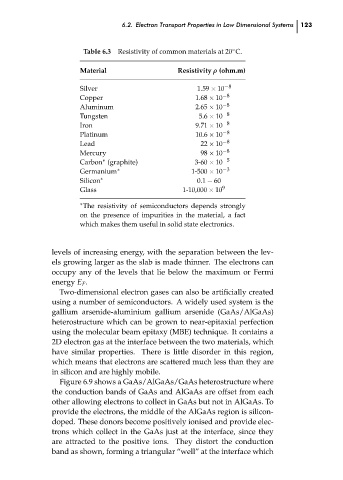
                                     Table 6.3 Resistivity of common materials at 20 C.
                                                                            ◦
                                    Material
                                                              Resistivity ρ (ohm.m)
                                                                          −8
                                                                   1.59 × 10
                                    Silver
                                                                         −8
                                    Copper
                                                                  1.68 × 10
                                                                         −8
                                    Aluminum
                                                                  2.65 × 10
                                                                         −8
                                                                   5.6 × 10
                                    Tungsten
                                                                         −8
                                    Iron
                                                                  9.71 × 10
                                                                         −8
                                    Platinum
                                                                  10.6 × 10
                                                                         −8
                                                                    22 × 10
                                    Lead
                                                                         −8
                                    Mercury
                                                                    98 × 10
                                                                         −5
                                                                  3-60 × 10
                                          ∗
                                    Carbon (graphite)
                                                                         −3
                                              ∗
                                    Germanium
                                                                 1-500 × 10
                                          ∗
                                                                   0.1 − 60
                                    Silicon
                                                                         9
                                                               1-10,000 × 10
                                    Glass
                                    ∗
                                     The resistivity of semiconductors depends strongly
                                    on the presence of impurities in the material, a fact
                                    which makes them useful in solid state electronics.
                             levels of increasing energy, with the separation between the lev-
                             els growing larger as the slab is made thinner. The electrons can
                             occupy any of the levels that lie below the maximum or Fermi
                             energy E F .
                               Two-dimensional electron gases can also be artificially created
                             using a number of semiconductors. A widely used system is the
                             gallium arsenide-aluminium gallium arsenide (GaAs/AlGaAs)
                             heterostructure which can be grown to near-epitaxial perfection
                             using the molecular beam epitaxy (MBE) technique. It contains a
                             2D electron gas at the interface between the two materials, which  123  ch06
                             have similar properties. There is little disorder in this region,
                             which means that electrons are scattered much less than they are
                             in silicon and are highly mobile.
                               Figure 6.9 shows a GaAs/AlGaAs/GaAs heterostructure where
                             the conduction bands of GaAs and AlGaAs are offset from each
                             other allowing electrons to collect in GaAs but not in AlGaAs. To
                             provide the electrons, the middle of the AlGaAs region is silicon-
                             doped. These donors become positively ionised and provide elec-
                             trons which collect in the GaAs just at the interface, since they
                             are attracted to the positive ions. They distort the conduction
                             band as shown, forming a triangular “well” at the interface which

