


Page 130 - Science at the nanoscale
P. 130
8:11
                                                     RPS: PSP0007 - Science-at-Nanoscale
                   June 9, 2009
                              Low-Dimensional Nanostructures
                         120
                                              States
                                              of
                                              Density
                                                        A A
                                                                   B B
                                                                           2
                                                               0
                                                 -2
                                                          energy (eV)
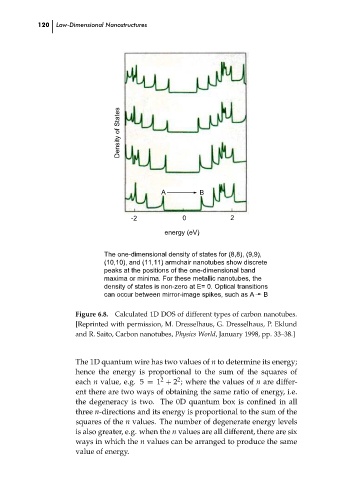
                                          The one-dimensional density of states for (8,8), (9,9),
                                          (10,10), and (11,11) armchair nanotubes show discrete
                                          peaks at the positions of the one-dimensional band
                                          maxima or minima. For these metallic nanotubes, the
                                          density of states is non-zero at E= 0. Optical transitions
                                          can occur between mirror-image spikes, such as A
                                                                                    B
                                   Figure 6.8. Calculated 1D DOS of different types of carbon nanotubes.
                                   [Reprinted with permission, M. Dresselhaus, G. Dresselhaus, P. Eklund
                                   and R. Saito, Carbon nanotubes, Physics World, January 1998, pp. 33–38.]  ch06
                                   The 1D quantum wire has two values of n to determine its energy;
                                   hence the energy is proportional to the sum of the squares of
                                                         2
                                                              2
                                   each n value, e.g. 5 = 1 + 2 ; where the values of n are differ-
                                   ent there are two ways of obtaining the same ratio of energy, i.e.
                                   the degeneracy is two. The 0D quantum box is confined in all
                                   three n-directions and its energy is proportional to the sum of the
                                   squares of the n values. The number of degenerate energy levels
                                   is also greater, e.g. when the n values are all different, there are six
                                   ways in which the n values can be arranged to produce the same
                                   value of energy.

