


Page 129 - Science at the nanoscale
P. 129
RPS: PSP0007 - Science-at-Nanoscale
                             8:11
                   June 9, 2009
                                                                  6.1. From 3D to 0D Nanostructures
                                                                1D
                                                  2D
                                     3D
                                                                               0D
                                             (Quantum Well)
                                                            (Quantum Wire)
                                    (bulk)
                                                                           (Quantum Dot)
                             g(E)
                                           g(E)
                                                         g(E)
                                                                       g(E)
                                                                      E
                                                                                    E
                                                        E
                                          E
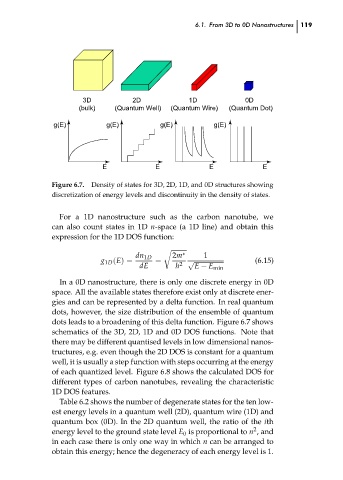
                                       Density of states for 3D, 2D, 1D, and 0D structures showing
                             Figure 6.7.
                             discretization of energy levels and discontinuity in the density of states.
                               For a 1D nanostructure such as the carbon nanotube, we
                             can also count states in 1D n-space (a 1D line) and obtain this
                             expression for the 1D DOS function:
                                                          r
                                                                    1
                                                            2m
                                                               ∗
                                                   dn 1D
                                                                                  (6.15)
                                                                √
                                                        =
                                          g 1D (E) =
                                                              2
                                                             h
                                                    dE
                                                                  E − E min
                               In a 0D nanostructure, there is only one discrete energy in 0D
                             space. All the available states therefore exist only at discrete ener-
                             gies and can be represented by a delta function. In real quantum
                             dots, however, the size distribution of the ensemble of quantum
                             dots leads to a broadening of this delta function. Figure 6.7 shows
                             schematics of the 3D, 2D, 1D and 0D DOS functions. Note that
                             there may be different quantised levels in low dimensional nanos-  119  ch06
                             tructures, e.g. even though the 2D DOS is constant for a quantum
                             well, it is usually a step function with steps occurring at the energy
                             of each quantized level. Figure 6.8 shows the calculated DOS for
                             different types of carbon nanotubes, revealing the characteristic
                             1D DOS features.
                               Table 6.2 shows the number of degenerate states for the ten low-
                             est energy levels in a quantum well (2D), quantum wire (1D) and
                             quantum box (0D). In the 2D quantum well, the ratio of the ith
                                                                                 2
                             energy level to the ground state level E 0 is proportional to n , and
                             in each case there is only one way in which n can be arranged to
                             obtain this energy; hence the degeneracy of each energy level is 1.

