


Page 124 - Science at the nanoscale
P. 124
8:11
                                                     RPS: PSP0007 - Science-at-Nanoscale
                   June 9, 2009
                              Low-Dimensional Nanostructures
                         114
                                                              Conduction
                                           Conduction
                                                                                Conduction
                                                                                  Band
                                             Band
                                                               Band
                                   E gap
                                                               Some electrons have
                                                                                    High
                                           At absolute
                                                                                    Temperature
                                                              energy above the Fermi
                                            zero, 0 K
                                                                    level.
                                   Fermi
                                   Level
                                                                       f(E)
                                                                                          f(E)
                                                     f(E)
                                                             Valence Band
                                          Valence Band
                                                                               Valence Band
                                                                                          1.0
                                                     1.0
                                                                        1.0
                                   No electrons can be above the valence band
                                                                      At high temperatures, some
                                                                      electrons can reach the conduction
                                   at 0 K, since none have energy above the
                                   Fermi level and there are no available energy
                                                                      band and contribute to electric current.
                                   states in the band gap.
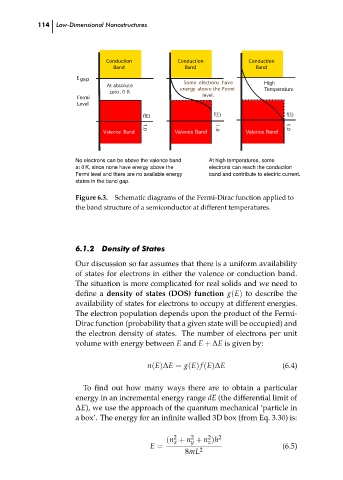
                                             Schematic diagrams of the Fermi-Dirac function applied to
                                   Figure 6.3.
                                   the band structure of a semiconductor at different temperatures.
                                          Density of States
                                   6.1.2
                                   Our discussion so far assumes that there is a uniform availability
                                   of states for electrons in either the valence or conduction band.
                                   The situation is more complicated for real solids and we need to
                                   define a density of states (DOS) function g(E) to describe the
                                   availability of states for electrons to occupy at different energies.
                                   The electron population depends upon the product of the Fermi-
                                   Dirac function (probability that a given state will be occupied) and
                                   the electron density of states. The number of electrons per unit  ch06
                                   volume with energy between E and E + ∆E is given by:
                                                      n(E)∆E = g(E) f (E)∆E              (6.4)
                                     To find out how many ways there are to obtain a particular
                                   energy in an incremental energy range dE (the differential limit of
                                   ∆E), we use the approach of the quantum mechanical ‘particle in
                                   a box’. The energy for an infinite walled 3D box (from Eq. 3.30) is:
                                                             2
                                                                     2
                                                                 2
                                                           (n + n + n )h 2
                                                                 y
                                                                     z
                                                             x
                                                      E =                                (6.5)
                                                               8mL 2

