


Page 126 - Science at the nanoscale
P. 126
8:11
                                                     RPS: PSP0007 - Science-at-Nanoscale
                   June 9, 2009
                              Low-Dimensional Nanostructures
                         116
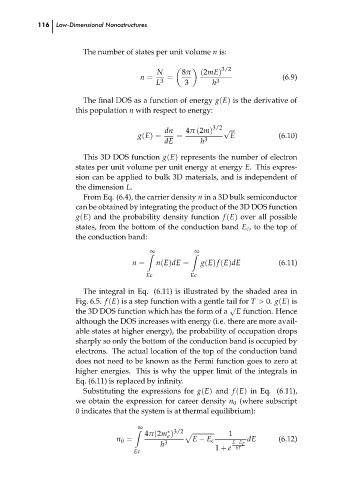
                                     The number of states per unit volume n is:
                                                                         3/2

                                                        N

                                                               8π
                                                                   (2mE)
                                                                                         (6.9)
                                                           =
                                                    n =
                                                                        3
                                                         3
                                                                       h
                                                        L
                                                               3
                                     The final DOS as a function of energy g(E) is the derivative of
                                   this population n with respect to energy:
                                                                       3/2
                                                          dn
                                                                         √
                                                                4π (2m)
                                                                                        (6.10)
                                                                           E
                                                             =
                                                   g(E) =
                                                                     3
                                                          dE
                                                                    h
                                     This 3D DOS function g(E) represents the number of electron
                                   states per unit volume per unit energy at energy E. This expres-
                                   sion can be applied to bulk 3D materials, and is independent of
                                   the dimension L.
                                     From Eq. (6.4), the carrier density n in a 3D bulk semiconductor
                                   can be obtained by integrating the product of the 3D DOS function
                                   g(E) and the probability density function f (E) over all possible
                                   states, from the bottom of the conduction band E c , to the top of
                                   the conduction band:
                                                                  ∞
                                                      ∞
                                                      Z
                                                                 Z
                                                                                        (6.11)
                                                                    g(E) f (E)dE
                                                  n =
                                                        n(E)dE =
                                                     Ec
                                                                 Ec
                                     The integral in Eq. (6.11) is illustrated by the shaded area in
                                   Fig. 6.5. f (E) is a step function with a gentle tail for T > 0. g(E) is
                                                                           √
                                                                             E function. Hence
                                   the 3D DOS function which has the form of a
                                   although the DOS increases with energy (i.e. there are more avail-
                                   able states at higher energy), the probability of occupation drops
                                   sharply so only the bottom of the conduction band is occupied by  ch06
                                   electrons. The actual location of the top of the conduction band
                                   does not need to be known as the Fermi function goes to zero at
                                   higher energies. This is why the upper limit of the integrals in
                                   Eq. (6.11) is replaced by infinity.
                                     Substituting the expressions for g(E) and f (E) in Eq. (6.11),
                                   we obtain the expression for career density n 0 (where subscript
                                   0 indicates that the system is at thermal equilibrium):
                                                   ∞
                                                  Z
                                                     4π(2m )               1
                                                           e
                                                           ∗ 3/2 p
                                              n 0 =       3      E − E c    E−E  dE     (6.12)
                                                         h                    F
                                                  Ec                   1 + e  kT

