


Page 123 - Science at the nanoscale
P. 123
RPS: PSP0007 - Science-at-Nanoscale
                             8:11
                   June 9, 2009
                                                                  6.1. From 3D to 0D Nanostructures
                               The Bose-Einstein and Fermi-Dirac distributions differ from the
                             classical Maxwell-Boltzmann distribution because the particles
                             they describe are indistinguishable. Particles are considered to be
                             indistinguishable if their wave packets overlap significantly. This
                             argument arises from the quantum mechanical hypothesis that
                             all particles have characteristic wave properties (cf. de Broglie
                             hypothesis). Two particles can only be considered distinguish-
                             able if their separation is large compared to their de Broglie wave-
                             length.
                               The Bose-Einstein distribution function is used to describe a
                             system of identical and indistinguishable particles with integer
                             spin (bosons), e.g. photons, giving the Planck radiation formula.
                             The Fermi-Dirac distribution function is used to describe a sys-
                             tem of identical but indistinguishable particles with half-integer
                             spin (fermions), e.g. electrons. As we shall be focusing mainly
                             on the electronic properties of nanostructures in this chapter, we
                             shall discuss the implications of the Fermi-Dirac function on the
                             electrical conductivity of a semiconductor.
                               The Fermi-Dirac distribution applies to fermions (e.g. electrons)
                             which must obey the Pauli exclusion principle. Relative to the
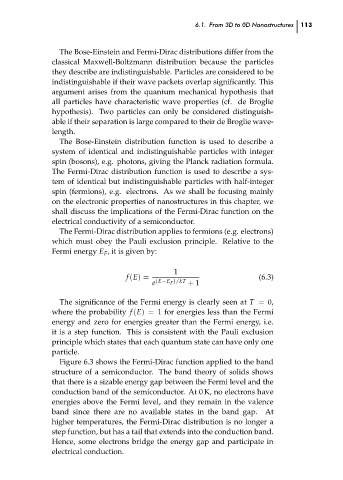
                             Fermi energy E F , it is given by:
                                                             1
                                                                                   (6.3)
                                                f (E) =
                                                        (E−E F )/kT
                                                                + 1
                                                       e
                               The significance of the Fermi energy is clearly seen at T = 0,
                             where the probability f (E) = 1 for energies less than the Fermi
                             energy and zero for energies greater than the Fermi energy, i.e.
                             it is a step function. This is consistent with the Pauli exclusion
                             principle which states that each quantum state can have only one  113  ch06
                             particle.
                               Figure 6.3 shows the Fermi-Dirac function applied to the band
                             structure of a semiconductor. The band theory of solids shows
                             that there is a sizable energy gap between the Fermi level and the
                             conduction band of the semiconductor. At 0 K, no electrons have
                             energies above the Fermi level, and they remain in the valence
                             band since there are no available states in the band gap. At
                             higher temperatures, the Fermi-Dirac distribution is no longer a
                             step function, but has a tail that extends into the conduction band.
                             Hence, some electrons bridge the energy gap and participate in
                             electrical conduction.

