


Page 120 - Science at the nanoscale
P. 120
8:11
                   June 9, 2009
                              Low-Dimensional Nanostructures
                         110
                                   to visualise the difference between conductors, insulators and
                                   semiconductors is to plot the available energies for electrons in
                                   the materials. Instead of having discrete energies as in the case of
                                   free atoms (cf. Chapter 3), the available energy states form bands.
                                   An important factor determining electron conduction is whether
                                   or not there are electrons in the conduction band.
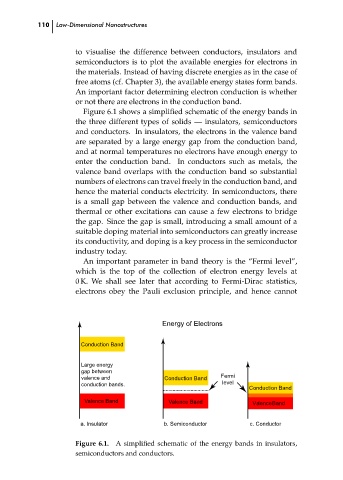
                                     Figure 6.1 shows a simplified schematic of the energy bands in
                                   the three different types of solids — insulators, semiconductors
                                   and conductors. In insulators, the electrons in the valence band
                                   are separated by a large energy gap from the conduction band,
                                   and at normal temperatures no electrons have enough energy to
                                   enter the conduction band. In conductors such as metals, the
                                   valence band overlaps with the conduction band so substantial
                                   numbers of electrons can travel freely in the conduction band, and
                                   hence the material conducts electricity. In semiconductors, there
                                   is a small gap between the valence and conduction bands, and
                                   thermal or other excitations can cause a few electrons to bridge
                                   the gap. Since the gap is small, introducing a small amount of a
                                   suitable doping material into semiconductors can greatly increase
                                   its conductivity, and doping is a key process in the semiconductor
                                   industry today.
                                     An important parameter in band theory is the “Fermi level”,
                                   which is the top of the collection of electron energy levels at
                                   0 K. We shall see later that according to Fermi-Dirac statistics,
                                   electrons obey the Pauli exclusion principle, and hence cannot
                                                          Energy of Electrons
                                    Conduction Band  RPS: PSP0007 - Science-at-Nanoscale           ch06
                                     Large energy
                                     gap between
                                     valence and          Conduction Band  Fermi
                                     conduction bands.                   level
                                                                                Conduction Band
                                     Valence Band          Valence Band          ValenceBand
                                    a. Insulator          b. Semiconductor      c. Conductor
                                   Figure 6.1.  A simplified schematic of the energy bands in insulators,
                                   semiconductors and conductors.

