


Page 116 - Science at the nanoscale
P. 116
9:10
                                                     RPS: PSP0007 - Science-at-Nanoscale
                   June 9, 2009
                              Surfaces at the Nanoscale
                         106
                                                  O
                                                     S O  O -  +                                   ch05
                                                O           Na
                                                       O                  AOT
                                                O
                                                  O
                                                 AOT
                                         Sodium bis(2-ethylhexyl )
                                            sulfosuccinate
                                                                               W/O
                                                 +
                                               +  +
                                               +   +
                                              + water  +    O/W      2 Φ
                                              + pool  +
                                               +   +
                                                +  +
                                                 +             WATER              ISOOCTANE
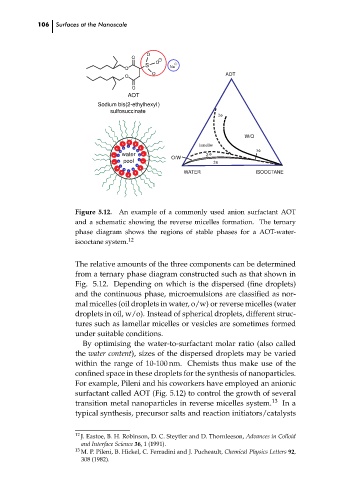
                                   Figure 5.12.  An example of a commonly used anion surfactant AOT
                                   and a schematic showing the reverse micelles formation. The ternary
                                   phase diagram shows the regions of stable phases for a AOT-water-
                                   isooctane system. 12

                                   The relative amounts of the three components can be determined
                                   from a ternary phase diagram constructed such as that shown in
                                   Fig. 5.12. Depending on which is the dispersed (fine droplets)
                                   and the continuous phase, microemulsions are classified as nor-
                                   mal micelles (oil droplets in water, o/w) or reverse micelles (water
                                   droplets in oil, w/o). Instead of spherical droplets, different struc-
                                   tures such as lamellar micelles or vesicles are sometimes formed
                                   under suitable conditions.
                                     By optimising the water-to-surfactant molar ratio (also called
                                   the water content), sizes of the dispersed droplets may be varied
                                   within the range of 10-100 nm. Chemists thus make use of the
                                   confined space in these droplets for the synthesis of nanoparticles.
                                   For example, Pileni and his coworkers have employed an anionic
                                   surfactant called AOT (Fig. 5.12) to control the growth of several
                                   transition metal nanoparticles in reverse micelles system. 13  In a
                                   typical synthesis, precursor salts and reaction initiators/catalysts

                                   12  J. Eastoe, B. H. Robinson, D. C. Steytler and D. Thornleeson, Advances in Colloid
                                     and Interface Science 36, 1 (1991).
                                   13  M. P. Pileni, B. Hickel, C. Ferradini and J. Pucheault, Chemical Physics Letters 92,
                                     308 (1982).

