


Page 111 - Science at the nanoscale
P. 111
RPS: PSP0007 - Science-at-Nanoscale
                             9:10
                   June 9, 2009
                                                                  5.2. Surface Reactivity and Catalysis
                               In general, we may divide the catalytic surface reaction into sev-
                             eral consecutive steps: (1) diffusion of reactants to the surface;
                             (2) adsorption of reactants at the surface; (3) chemical transforma-  101  ch05
                             tion of the adsorbed molecule, (4) reaction on the surface; (4) des-
                             orption of products from the surface; (5) diffusion of products
                             away from the surface. Suppose any of these steps has a much
                             lower rate constant than all the others, it will become the rate
                             determining step and control the overall rate of reaction. Thus,
                             while higher surface area causes smaller particles to react faster,
                             the situation is less straight-forward for heterogeneous solid cata-
                             lytic reactions.
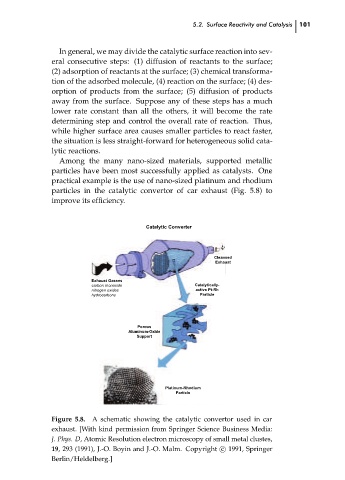
                               Among the many nano-sized materials, supported metallic
                             particles have been most successfully applied as catalysts. One
                             practical example is the use of nano-sized platinum and rhodium
                             particles in the catalytic convertor of car exhaust (Fig. 5.8) to
                             improve its efficiency.


                                                      Catalytic Converter


                                                                       Cleansed
                                                                        Exhaust
                                       Exhaust Gasses
                                       carbon monoxide            Catalytically-
                                       nitrogen oxides            active Pt-Rh
                                       hydrocarbons                 Particle


                                                   Porous
                                                 Aluminum-Oxide
                                                   Support


                                                           Platinum-Rhodium
                                                             Particle


                             Figure 5.8.  A schematic showing the catalytic convertor used in car
                             exhaust. [With kind permission from Springer Science Business Media:
                             J. Phys. D, Atomic Resolution electron microscopy of small metal clustes,
                             19, 293 (1991), J.-O. Boyin and J.-O. Malm. Copyright c
 1991, Springer
                             Berlin/Heldelberg.]

