


Page 110 - Science at the nanoscale
P. 110
9:10
                                                     RPS: PSP0007 - Science-at-Nanoscale
                   June 9, 2009
                              Surfaces at the Nanoscale
                         100
                                   5.2 SURFACE REACTIVITY AND CATALYSIS
                                   In chemical reactions involving a solid material, the surface area  ch05
                                   to volume ratio plays an important role in the reactivity. This is
                                   analogous to the situation where finely crushed ice melts faster
                                   than ice cubes. Materials with higher surface area are expected to
                                   react more readily because more surface sites are available to react.
                                   A famous historical example is the destructive explosion caused
                                   by a spark and flour dust in the “Great Mill Disaster” accident in
                                        5
                                   1878; while grain is not typically flammable, grain dust becomes
                                   explosive due to its extremely high surface energy. Thermody-
                                   namically, a high surface area provides a strong “driving force”
                                   that speeds up processes in the quest to minimise free energy.
                                     High surface area can be achieved either by using materials of
                                   very small sizes or materials that possess highly porous struc-
                                                                                       6
                                   tures. In the latter, microporous materials such as zeolites have
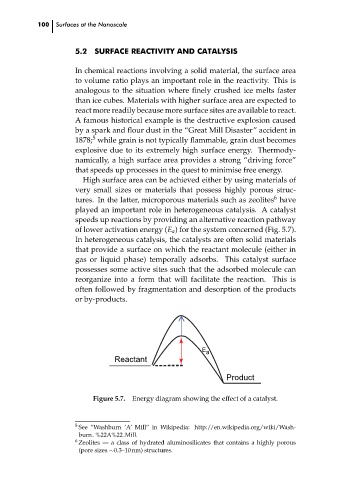
                                   played an important role in heterogeneous catalysis. A catalyst
                                   speeds up reactions by providing an alternative reaction pathway
                                   of lower activation energy (E a ) for the system concerned (Fig. 5.7).
                                   In heterogeneous catalysis, the catalysts are often solid materials
                                   that provide a surface on which the reactant molecule (either in
                                   gas or liquid phase) temporally adsorbs. This catalyst surface
                                   possesses some active sites such that the adsorbed molecule can
                                   reorganize into a form that will facilitate the reaction. This is
                                   often followed by fragmentation and desorption of the products
                                   or by-products.


                                                                    E a
                                             Reactant

                                                                          Product

                                        Figure 5.7.  Energy diagram showing the effect of a catalyst.


                                   5  See “Washburn ‘A’ Mill” in Wikipedia: http://en.wikipedia.org/wiki/Wash-
                                    burn %22A%22 Mill.
                                   6  Zeolites — a class of hydrated aluminosilicates that contains a highly porous
                                    (pore sizes ∼0.3–10 nm) structures.

