


Page 107 - Science at the nanoscale
P. 107
9:10
                   June 9, 2009
                             the lowest Gibbs free energy. In order to lower the free energy,
                             some surface processes such as surface relaxation or reconstruc-
                             tion will occur naturally.  RPS: PSP0007 - Science-at-Nanoscale 5.1. Surface Energy  97  ch05
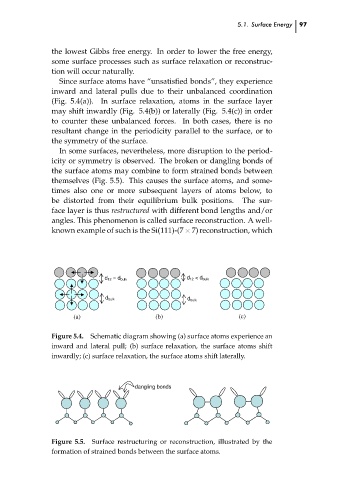
                               Since surface atoms have “unsatisfied bonds”, they experience
                             inward and lateral pulls due to their unbalanced coordination
                             (Fig. 5.4(a)). In surface relaxation, atoms in the surface layer
                             may shift inwardly (Fig. 5.4(b)) or laterally (Fig. 5.4(c)) in order
                             to counter these unbalanced forces. In both cases, there is no
                             resultant change in the periodicity parallel to the surface, or to
                             the symmetry of the surface.
                               In some surfaces, nevertheless, more disruption to the period-
                             icity or symmetry is observed. The broken or dangling bonds of
                             the surface atoms may combine to form strained bonds between
                             themselves (Fig. 5.5). This causes the surface atoms, and some-
                             times also one or more subsequent layers of atoms below, to
                             be distorted from their equilibrium bulk positions.  The sur-
                             face layer is thus restructured with different bond lengths and/or
                             angles. This phenomenon is called surface reconstruction. A well-
                             known example of such is the Si(111)-(7 × 7) reconstruction, which


                                           d 12  = d bulk       d 12  < d bulk

                                           d bulk               d bulk

                                   (a)                  (b)                   (c)

                             Figure 5.4.  Schematic diagram showing (a) surface atoms experience an
                             inward and lateral pull; (b) surface relaxation, the surface atoms shift
                             inwardly; (c) surface relaxation, the surface atoms shift laterally.


                                                   dangling bonds


                             Figure 5.5.  Surface restructuring or reconstruction, illustrated by the
                             formation of strained bonds between the surface atoms.

