


Page 104 - Science at the nanoscale
P. 104
9:10
                                                     RPS: PSP0007 - Science-at-Nanoscale
                   June 9, 2009
                              Surfaces at the Nanoscale
                          94
                                                                                1 nm 3             ch05
                                                         1 cm
                                            1 cm 3                             gold cube
                                           gold cube
                                                                      Unit cell length of gold ~ 0.4nm
                                                                       Approximately 2.5 fcc units
                                                      1 cm
                                             1 cm
                                      Total number of atoms ~ 5.9 x10  22  Total number of atoms ~ 108
                                     Number of surface atoms ~1.2 x10  15  Number of surface atoms ~ 84
                                                               _
                                   % of surface atoms to total atoms ~ 2 x10  6  % of surface atoms to total atoms ~ 78
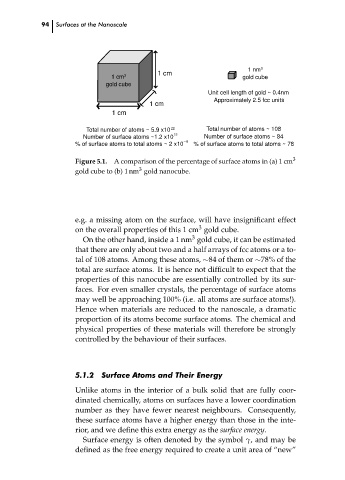
                                   Figure 5.1.  A comparison of the percentage of surface atoms in (a) 1 cm 3
                                                    3
                                   gold cube to (b) 1 nm gold nanocube.


                                   e.g. a missing atom on the surface, will have insignificant effect
                                                                   3
                                   on the overall properties of this 1 cm gold cube.
                                                                  3
                                     On the other hand, inside a 1 nm gold cube, it can be estimated
                                   that there are only about two and a half arrays of fcc atoms or a to-
                                   tal of 108 atoms. Among these atoms, ∼84 of them or ∼78% of the
                                   total are surface atoms. It is hence not difficult to expect that the
                                   properties of this nanocube are essentially controlled by its sur-
                                   faces. For even smaller crystals, the percentage of surface atoms
                                   may well be approaching 100% (i.e. all atoms are surface atoms!).
                                   Hence when materials are reduced to the nanoscale, a dramatic
                                   proportion of its atoms become surface atoms. The chemical and
                                   physical properties of these materials will therefore be strongly
                                   controlled by the behaviour of their surfaces.


                                   5.1.2  Surface Atoms and Their Energy

                                   Unlike atoms in the interior of a bulk solid that are fully coor-
                                   dinated chemically, atoms on surfaces have a lower coordination
                                   number as they have fewer nearest neighbours. Consequently,
                                   these surface atoms have a higher energy than those in the inte-
                                   rior, and we define this extra energy as the surface energy.
                                     Surface energy is often denoted by the symbol γ, and may be
                                   defined as the free energy required to create a unit area of “new”

