


Page 109 - Science at the nanoscale
P. 109
9:10
                   June 9, 2009
                                                                        (b)
                                         (a)         RPS: PSP0007 - Science-at-Nanoscale 5.1. Surface Energy  99  ch05
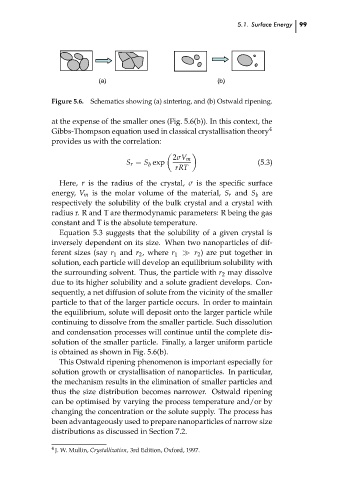
                             Figure 5.6.  Schematics showing (a) sintering, and (b) Ostwald ripening.

                             at the expense of the smaller ones (Fig. 5.6(b)). In this context, the
                             Gibbs-Thompson equation used in classical crystallisation theory 4
                             provides us with the correlation:


                                                             2σV m
                                                S r = S exp                        (5.3)
                                                      b
                                                             rRT
                               Here, r is the radius of the crystal, σ is the specific surface
                             energy, V m is the molar volume of the material, S r and S are
                                                                                  b
                             respectively the solubility of the bulk crystal and a crystal with
                             radius r. R and T are thermodynamic parameters: R being the gas
                             constant and T is the absolute temperature.
                               Equation 5.3 suggests that the solubility of a given crystal is
                             inversely dependent on its size. When two nanoparticles of dif-
                             ferent sizes (say r 1 and r 2 , where r 1 ≫ r 2 ) are put together in
                             solution, each particle will develop an equilibrium solubility with
                             the surrounding solvent. Thus, the particle with r 2 may dissolve
                             due to its higher solubility and a solute gradient develops. Con-
                             sequently, a net diffusion of solute from the vicinity of the smaller
                             particle to that of the larger particle occurs. In order to maintain
                             the equilibrium, solute will deposit onto the larger particle while
                             continuing to dissolve from the smaller particle. Such dissolution
                             and condensation processes will continue until the complete dis-
                             solution of the smaller particle. Finally, a larger uniform particle
                             is obtained as shown in Fig. 5.6(b).
                               This Ostwald ripening phenomenon is important especially for
                             solution growth or crystallisation of nanoparticles. In particular,
                             the mechanism results in the elimination of smaller particles and
                             thus the size distribution becomes narrower. Ostwald ripening
                             can be optimised by varying the process temperature and/or by
                             changing the concentration or the solute supply. The process has
                             been advantageously used to prepare nanoparticles of narrow size
                             distributions as discussed in Section 7.2.

                             4  J. W. Mullin, Crystallization, 3rd Edition, Oxford, 1997.

