


Page 114 - Science at the nanoscale
P. 114
9:10
                   June 9, 2009
                              Surfaces at the Nanoscale
                         104
                                                  V  RPS: PSP0007 - Science-at-Nanoscale           ch05
                                                   R
                                                            Total potential
                                        energy  O  V max    energy
                                        Potential            Secondary minimum
                                                                        Distance between surfaces

                                               V
                                                A
                                               Primary minimum


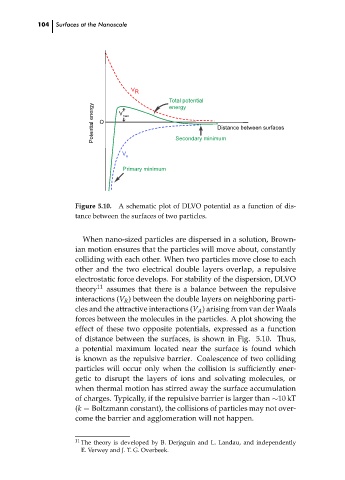
                                   Figure 5.10.  A schematic plot of DLVO potential as a function of dis-
                                   tance between the surfaces of two particles.

                                     When nano-sized particles are dispersed in a solution, Brown-
                                   ian motion ensures that the particles will move about, constantly
                                   colliding with each other. When two particles move close to each
                                   other and the two electrical double layers overlap, a repulsive
                                   electrostatic force develops. For stability of the dispersion, DLVO
                                   theory 11  assumes that there is a balance between the repulsive
                                   interactions (V R ) between the double layers on neighboring parti-
                                   cles and the attractive interactions (V A ) arising from van der Waals
                                   forces between the molecules in the particles. A plot showing the
                                   effect of these two opposite potentials, expressed as a function
                                   of distance between the surfaces, is shown in Fig. 5.10. Thus,
                                   a potential maximum located near the surface is found which
                                   is known as the repulsive barrier. Coalescence of two colliding
                                   particles will occur only when the collision is sufficiently ener-
                                   getic to disrupt the layers of ions and solvating molecules, or
                                   when thermal motion has stirred away the surface accumulation
                                   of charges. Typically, if the repulsive barrier is larger than ∼10 kT
                                   (k = Boltzmann constant), the collisions of particles may not over-
                                   come the barrier and agglomeration will not happen.

                                   11  The theory is developed by B. Derjaguin and L. Landau, and independently
                                     E. Verwey and J. T. G. Overbeek.

