


Page 115 - Science at the nanoscale
P. 115
RPS: PSP0007 - Science-at-Nanoscale
                             9:10
                   June 9, 2009
                                                                          5.3. Surface stabilisation
                               While electrostatic stabilisation is very useful for the prepara-
                             tion of stable colloidal systems, the method is difficult to apply
                             to multiphase systems (e.g. different solids that carry different  105  ch05
                             surface charges), and also to electrolyte-sensitive systems. Fur-
                             thermore, this process is a kinetic stabilization, and it is almost
                             impossible for the agglomerated particles to be re-dispersed.
                             Alternatively, steric or electrosteric stabilisation using polymers
                             or surfactants are applied in most solution preparations of nano-
                             particles.
                             5.3.2  Surfactants and Microemulsions
                             Surfactant is the acronym for “surface-active agent”. These are
                             molecules typically consist of two parts: a long-chain hydrocar-
                             bon (hydrophobic tail) and a polar group at one end (hydrophilic
                             head). Some examples of surfactants include salts of carboxylic
                                                                                −
                                                 −
                             acid (i.e. soaps, RCOO Na ) and alkyl sulfate (ROSO 2 O Na ),
                                                     +
                                                                                    +
                             where R = hydrocarbon chain.     When these molecules are
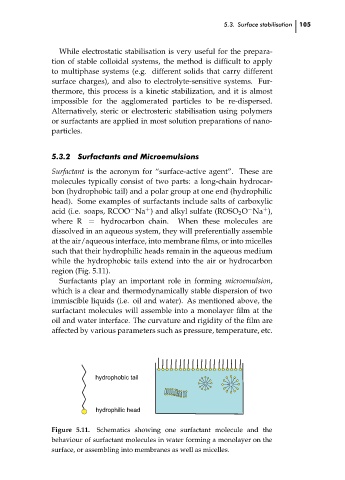
                             dissolved in an aqueous system, they will preferentially assemble
                             at the air/aqueous interface, into membrane films, or into micelles
                             such that their hydrophilic heads remain in the aqueous medium
                             while the hydrophobic tails extend into the air or hydrocarbon
                             region (Fig. 5.11).
                               Surfactants play an important role in forming microemulsion,
                             which is a clear and thermodynamically stable dispersion of two
                             immiscible liquids (i.e. oil and water). As mentioned above, the
                             surfactant molecules will assemble into a monolayer film at the
                             oil and water interface. The curvature and rigidity of the film are
                             affected by various parameters such as pressure, temperature, etc.


                                        hydrophobic tail


                                        hydrophilic head


                             Figure 5.11.  Schematics showing one surfactant molecule and the
                             behaviour of surfactant molecules in water forming a monolayer on the
                             surface, or assembling into membranes as well as micelles.

