


Page 106 - Science at the nanoscale
P. 106
9:10
                                                     RPS: PSP0007 - Science-at-Nanoscale
                   June 9, 2009
                              Surfaces at the Nanoscale
                          96
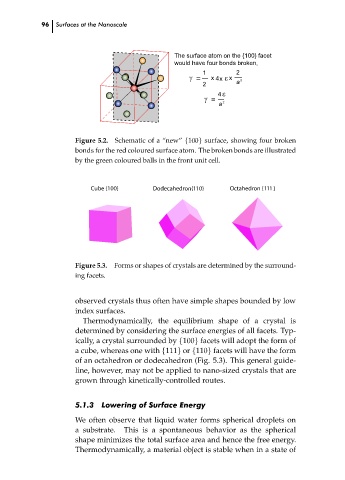
                                                             The surface atom on the {100} facet
                                                             would have four bonds broken,         ch05
                                                                    1        2
                                                                 γ  =  x x ε 4  x  2
                                                                    2        a
                                                                        4ε
                                                                     γ  =
                                                                        a  2
                                   Figure 5.2. Schematic of a “new” {100} surface, showing four broken
                                   bonds for the red coloured surface atom. The broken bonds are illustrated
                                   by the green coloured balls in the front unit cell.


                                       Cube {100}      Dodecahedron{110}   Octahedron {111}


                                   Figure 5.3.  Forms or shapes of crystals are determined by the surround-
                                   ing facets.


                                   observed crystals thus often have simple shapes bounded by low
                                   index surfaces.
                                     Thermodynamically, the equilibrium shape of a crystal is
                                   determined by considering the surface energies of all facets. Typ-
                                   ically, a crystal surrounded by {100} facets will adopt the form of
                                   a cube, whereas one with {111} or {110} facets will have the form
                                   of an octahedron or dodecahedron (Fig. 5.3). This general guide-
                                   line, however, may not be applied to nano-sized crystals that are
                                   grown through kinetically-controlled routes.


                                   5.1.3  Lowering of Surface Energy

                                   We often observe that liquid water forms spherical droplets on
                                   a substrate.  This is a spontaneous behavior as the spherical
                                   shape minimizes the total surface area and hence the free energy.
                                   Thermodynamically, a material object is stable when in a state of

