


Page 122 - Science at the nanoscale
P. 122
8:11
                                                     RPS: PSP0007 - Science-at-Nanoscale
                   June 9, 2009
                              Low-Dimensional Nanostructures
                         112
                                   defined by:
                                                                  k
                                   where k is the Boltzmann constant. The Fermi level plays an
                                   important role in the band theory of solids. In p-type and n-type
                                   doped semiconductors, the Fermi level is shifted by the dopant
                                   impurities. The Fermi level is referred to as the electron chemical
                                   potential in the chemistry context.
                                   6.1.1
                                          Energy Distribution Functions
                                   We next introduce the important statistical mechanics concept of
                                   energy distribution functions. The distribution function f (E) is
                                   the probability that a particle is in energy state E. f (E) is a gen-
                                   eralization of the ideas of discrete probability to the case where
                                   energy E can be treated as a continuous variable. Three dis-
                                   tinctly different distribution functions are found in nature — the
                                   Maxwell-Boltzmann, Bose-Einstein, and Fermi-Dirac distribution
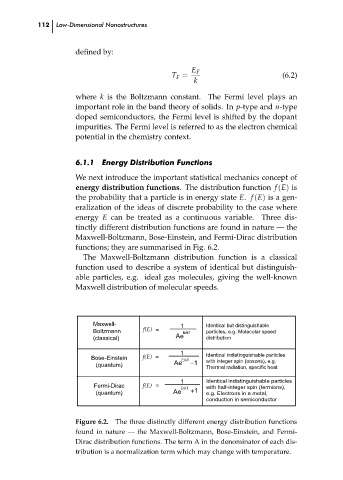
                                   functions; they are summarised in Fig. 6.2.
                                     The Maxwell-Boltzmann distribution function is a classical
                                   function used to describe a system of identical but distinguish-
                                   able particles, e.g. ideal gas molecules, giving the well-known
                                   Maxwell distribution of molecular speeds.
                                        Maxwell-
                                                              1
                                        Boltzmann
                                                                     particles, e.g. Molecular speed
                                                               E/kT
                                                             Ae
                                                                     distribution
                                        (classical)  f(E) =  T F =  E F  Identical but distinguishable  (6.2)  ch06
                                                              1      Identical indistinguishable particles
                                       Bose-Einstein  f(E) =   E/kT  with integer spin (bosons), e.g.
                                        (quantum)            Ae  −1
                                                                     Thermal radiation, specific heat
                                                              1      Identical indistinguishable particles
                                        Fermi-Dirac  f(E) =   E/kT   with half-integer spin (fermions),
                                        (quantum)           Ae   +1  e.g. Electrons in a metal,
                                                                     conduction in semiconductor
                                   Figure 6.2.  The three distinctly different energy distribution functions
                                   found in nature — the Maxwell-Boltzmann, Bose-Einstein, and Fermi-
                                   Dirac distribution functions. The term A in the denominator of each dis-
                                   tribution is a normalization term which may change with temperature.

