


Page 134 - Science at the nanoscale
P. 134
8:11
                                                     RPS: PSP0007 - Science-at-Nanoscale
                   June 9, 2009
                              Low-Dimensional Nanostructures
                         124
                                                         V
                                                               Surface
                                                                         GaAs
                                                    +
                                                    +
                                                    +
                                                                         AlGaAs
                                                    +
                                                                         GaAs
                                                   E
                                                               Substrate
                                                    f
                                                       E c
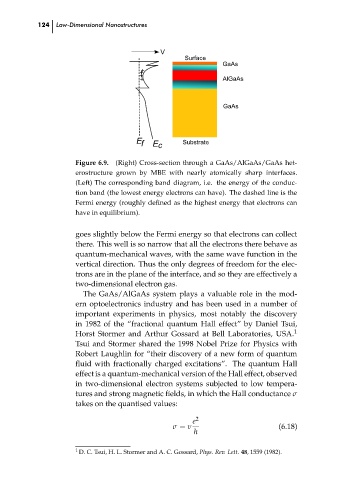
                                   Figure 6.9.
                                             (Right) Cross-section through a GaAs/AlGaAs/GaAs het-
                                   erostructure grown by MBE with nearly atomically sharp interfaces.
                                   (Left) The corresponding band diagram, i.e. the energy of the conduc-
                                   tion band (the lowest energy electrons can have). The dashed line is the
                                   Fermi energy (roughly defined as the highest energy that electrons can
                                   have in equilibrium).
                                   goes slightly below the Fermi energy so that electrons can collect
                                   there. This well is so narrow that all the electrons there behave as
                                   quantum-mechanical waves, with the same wave function in the
                                   vertical direction. Thus the only degrees of freedom for the elec-
                                   trons are in the plane of the interface, and so they are effectively a
                                   two-dimensional electron gas.
                                     The GaAs/AlGaAs system plays a valuable role in the mod-
                                   ern optoelectronics industry and has been used in a number of
                                   important experiments in physics, most notably the discovery
                                   in 1982 of the “fractional quantum Hall effect” by Daniel Tsui,
                                   Horst Stormer and Arthur Gossard at Bell Laboratories, USA. 1   ch06
                                   Tsui and Stormer shared the 1998 Nobel Prize for Physics with
                                   Robert Laughlin for “their discovery of a new form of quantum
                                   fluid with fractionally charged excitations”. The quantum Hall
                                   effect is a quantum-mechanical version of the Hall effect, observed
                                   in two-dimensional electron systems subjected to low tempera-
                                   tures and strong magnetic fields, in which the Hall conductance σ
                                   takes on the quantised values:
                                                                 e 2
                                                            σ = ν                       (6.18)
                                                                  h
                                   1  D. C. Tsui, H. L. Stormer and A. C. Gossard, Phys. Rev. Lett. 48, 1559 (1982).

