


Page 218 - Science at the nanoscale
P. 218
10:17
                                                     RPS: PSP0007 - Science-at-Nanoscale
                   June 5, 2009
                              Future Trends
                         208
                                   The concept of molecular electronics has created much excite-
                                   ment among scientists and technologists due to the prospect of
                                   size reduction in electronics offered by the molecular-level con-
                                   trol of properties. Although the original molecular rectifier was
                                   predicted as far back as 1974, a commercialisable single molecule
                                   device has yet to be demonstrated.
                                     The past few decades has seen the discovery of fascinating new
                                   allotropes of carbon. The fullerenes, discovered in 1985 by Robert
                                   Curl, Harold Kroto and Richard Smalley, are a family of car-
                                   bon allotropes named after Richard Buckminster Fuller and are
                                   sometimes also called buckyballs. Kroto, Curl, and Smalley were
                                   awarded the 1996 Nobel Prize in Chemistry for their discovery
                                   of this class of compounds. Fullerenes are molecules composed
                                   entirely of carbon, in the form of a hollow sphere, ellipsoid, or
                                   tube. Cylindrical fullerenes are called carbon nanotubes. Fullerenes
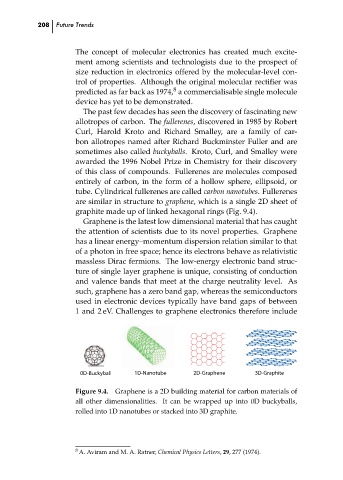
                                   are similar in structure to graphene, which is a single 2D sheet of
                                   graphite made up of linked hexagonal rings (Fig. 9.4).
                                     Graphene is the latest low dimensional material that has caught
                                   the attention of scientists due to its novel properties. Graphene
                                   has a linear energy–momentum dispersion relation similar to that
                                   of a photon in free space; hence its electrons behave as relativistic
                                   massless Dirac fermions. The low-energy electronic band struc-
                                   ture of single layer graphene is unique, consisting of conduction
                                   and valence bands that meet at the charge neutrality level. As
                                   such, graphene has a zero band gap, whereas the semiconductors
                                   used in electronic devices typically have band gaps of between
                                   1 and 2 eV. Challenges to graphene electronics therefore include
                                    0D-Buckyball  1D-Nanotube  8  2D-Graphene     3D-Graphite      ch09
                                   Figure 9.4.  Graphene is a 2D building material for carbon materials of
                                   all other dimensionalities. It can be wrapped up into 0D buckyballs,
                                   rolled into 1D nanotubes or stacked into 3D graphite.
                                   8  A. Aviram and M. A. Ratner, Chemical Physics Letters, 29, 277 (1974).

