


Page 215 - Science at the nanoscale
P. 215
RPS: PSP0007 - Science-at-Nanoscale
                             10:17
                   June 5, 2009
                                                                9.3. Spintronics and Surface Chemistry
                             (GMR)”. GMR is a quantum mechanical effect observed in
                             thin film structures composed of alternating ferromagnetic and
                             nonmagnetic metal layers. The effect manifests itself as a signif-
                             icant decrease in electrical resistance in the presence of a mag-
                             netic field. The Nobel Foundation’s press release interestingly
                                                        6
                             concludes with this paragraph :
                                 “The GMR effect was discovered thanks to new techniques developed
                                 during the 1970s to produce very thin layers of different materials. If
                                 GMR is to work, structures consisting of layers that are only a few
                                 atoms thick have to be produced. For this reason GMR can also be
                                 considered one of the first real applications of the promising field of
                                 nanotechnology.”
                               The discovery was made in 1988, and it was realised that this
                             effect would make it possible to manufacture very sensitive mag-
                             netic read heads for hard disks.
                                                             In a remarkably short time,
                             GMR technology was incorporated into their hard drive head
                             and launched onto the market by IBM in 1997. This invention
                             is responsible for the ultra-high density disk drives in MP3 play-
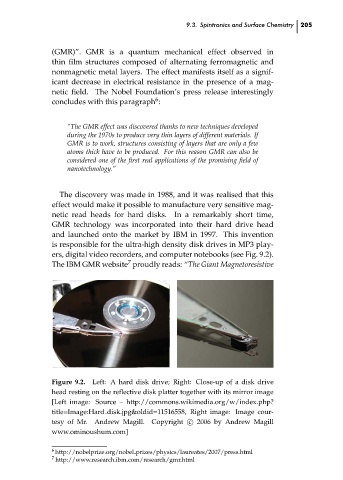
                             ers, digital video recorders, and computer notebooks (see Fig. 9.2).
                                                 7
                             The IBM GMR website proudly reads: “The Giant Magnetoresistive
                             Figure 9.2.  Left: A hard disk drive; Right: Close-up of a disk drive  205  ch09
                             head resting on the reflective disk platter together with its mirror image
                             [Left image: Source – http://commons.wikimedia.org/w/index.php?
                             title=Image:Hard disk.jpg&oldid=11516558, Right image: Image cour-
                             tesy of Mr.  Andrew Magill.  Copyright c
 2006 by Andrew Magill
                             www.ominoushum.com]
                             6  http://nobelprize.org/nobel prizes/physics/laureates/2007/press.html
                             7  http://www.research.ibm.com/research/gmr.html

