


Page 216 - Science at the nanoscale
P. 216
10:17
                                                     RPS: PSP0007 - Science-at-Nanoscale
                   June 5, 2009
                              Future Trends
                         206
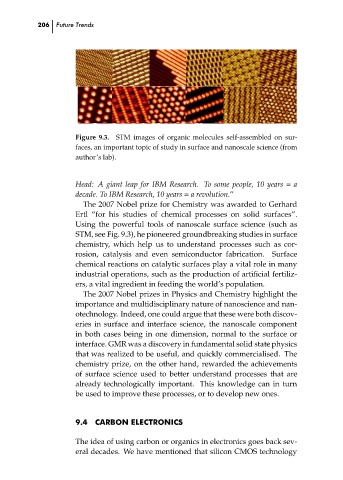
                                              STM images of organic molecules self-assembled on sur-
                                   Figure 9.3.
                                   faces, an important topic of study in surface and nanoscale science (from
                                   author’s lab).
                                   Head: A giant leap for IBM Research. To some people, 10 years = a
                                   decade. To IBM Research, 10 years = a revolution.”
                                     The 2007 Nobel prize for Chemistry was awarded to Gerhard
                                   Ertl “for his studies of chemical processes on solid surfaces”.
                                   Using the powerful tools of nanoscale surface science (such as
                                   STM, see Fig. 9.3), he pioneered groundbreaking studies in surface
                                   chemistry, which help us to understand processes such as cor-
                                   rosion, catalysis and even semiconductor fabrication. Surface
                                   chemical reactions on catalytic surfaces play a vital role in many
                                   industrial operations, such as the production of artificial fertiliz-
                                   ers, a vital ingredient in feeding the world’s population.
                                     The 2007 Nobel prizes in Physics and Chemistry highlight the
                                   importance and multidisciplinary nature of nanoscience and nan-
                                   otechnology. Indeed, one could argue that these were both discov-
                                   eries in surface and interface science, the nanoscale component
                                   in both cases being in one dimension, normal to the surface or  ch09
                                   interface. GMR was a discovery in fundamental solid state physics
                                   that was realized to be useful, and quickly commercialised. The
                                   chemistry prize, on the other hand, rewarded the achievements
                                   of surface science used to better understand processes that are
                                   already technologically important. This knowledge can in turn
                                   be used to improve these processes, or to develop new ones.
                                   9.4 CARBON ELECTRONICS
                                   The idea of using carbon or organics in electronics goes back sev-
                                   eral decades. We have mentioned that silicon CMOS technology

