


Page 213 - Science at the nanoscale
P. 213
RPS: PSP0007 - Science-at-Nanoscale
                             10:17
                   June 5, 2009
                                                                         9.2. Beyond Moore’s Law
                                                        Others
                                                         9%
                                               Aerospace
                                                  6%
                                                                      Materials
                                          Chemical
                                                                        31%
                                         manufacturing
                                            9%
                                       Pharmaceuticals
                                           17%
                                                             Electronics
                                                               28%
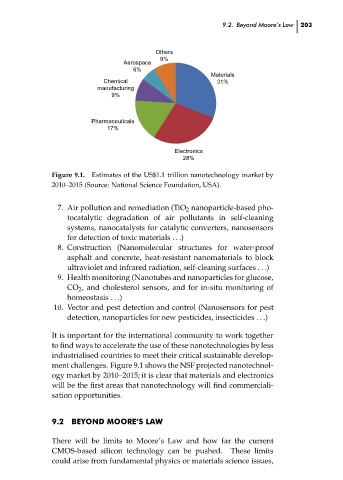
                                       Estimates of the US$1.1 trillion nanotechnology market by
                             Figure 9.1.
                             2010–2015 (Source: National Science Foundation, USA).
                              7. Air pollution and remediation (TiO 2 nanoparticle-based pho-
                                 tocatalytic degradation of air pollutants in self-cleaning
                                 systems, nanocatalysts for catalytic converters, nanosensors
                                 for detection of toxic materials . . .)
                              8. Construction (Nanomolecular structures for water-proof
                                 asphalt and concrete, heat-resistant nanomaterials to block
                                 ultraviolet and infrared radiation, self-cleaning surfaces . . .)
                              9. Health monitoring (Nanotubes and nanoparticles for glucose,
                                 CO 2 , and cholesterol sensors, and for in-situ monitoring of
                                 homeostasis . . .)
                             10. Vector and pest detection and control (Nanosensors for pest
                                 detection, nanoparticles for new pesticides, insecticides . . .)
                             It is important for the international community to work together  203  ch09
                             to find ways to accelerate the use of these nanotechnologies by less
                             industrialised countries to meet their critical sustainable develop-
                             ment challenges. Figure 9.1 shows the NSF projected nanotechnol-
                             ogy market by 2010–2015; it is clear that materials and electronics
                             will be the first areas that nanotechnology will find commerciali-
                             sation opportunities.
                             9.2  BEYOND MOORE’S LAW
                             There will be limits to Moore’s Law and how far the current
                             CMOS-based silicon technology can be pushed.  These limits
                             could arise from fundamental physics or materials science issues,

