


Page 262 - Semiconductor Manufacturing Handbook
P. 262
Geng(SMH)_CH18.qxd 04/04/2005 19:58 Page 18.3
WET CLEANING
WET CLEANING 18.3
ionic distribution in the liquid and can act as a repulsive or an attractive force. If the particle and the
wafer surface have like charges, the force is repulsive and therefore aids in particle removal. The
forces developed from these interactions can be quite large when compared to van der Waals forces
6
and also act over greater distances. This phenomenon is described by the DLVO theory (developed
by Derjaguin and Landau, Verwey, and Overbeek, independently) that characterized the interactions
between two of the same colloidal particles. The DLVO theory is further extended by Hogg, Healy,
and Fuersteanu (HHF) among others to describe the interaction between a colloidal particle and a
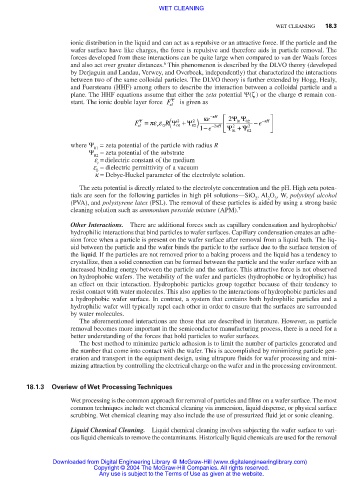
plane. The HHF equations assume that either the zeta potential Ψ(ζ ) or the charge σ remain con-
Ψ
stant. The ionic double layer force F is given as
el
r (
H
Ψ
01
2
2
F = pe e 0 R Ψ + Ψ ) e k −k − k H 2 ΨΨ 02 − e −k H
el
02
01
2
2
1 − e 2 Ψ + Ψ 02
01
where Ψ = zeta potential of the particle with radius R
01
Ψ = zeta potential of the substrate
02
e = dielectric constant of the medium
r
e = dielectric permittivity of a vacuum
0
k = Debye-Huckel parameter of the electrolyte solution.
The zeta potential is directly related to the electrolyte concentration and the pH. High zeta poten-
tials are seen for the following particles in high pH solutions—SiO , Al O , W, polyvinyl alcohol
2 2 3
(PVA), and polystyrene latex (PSL). The removal of these particles is aided by using a strong basic
cleaning solution such as ammonium peroxide mixture (APM). 7
Other Interactions. There are additional forces such as capillary condensation and hydrophobic/
hydrophilic interactions that bind particles to wafer surfaces. Capillary condensation creates an adhe-
sion force when a particle is present on the wafer surface after removal from a liquid bath. The liq-
uid between the particle and the wafer binds the particle to the surface due to the surface tension of
the liquid. If the particles are not removed prior to a baking process and the liquid has a tendency to
crystallize, then a solid connection can be formed between the particle and the wafer surface with an
increased binding energy between the particle and the surface. This attractive force is not observed
on hydrophobic wafers. The wetability of the wafer and particles (hydrophobic or hydrophilic) has
an effect on their interaction. Hydrophobic particles group together because of their tendency to
resist contact with water molecules. This also applies to the interactions of hydrophobic particles and
a hydrophobic wafer surface. In contrast, a system that contains both hydrophilic particles and a
hydrophilic wafer will typically repel each other in order to ensure that the surfaces are surrounded
by water molecules.
The aforementioned interactions are those that are described in literature. However, as particle
removal becomes more important in the semiconductor manufacturing process, there is a need for a
better understanding of the forces that hold particles to wafer surfaces.
The best method to minimize particle adhesion is to limit the number of particles generated and
the number that come into contact with the wafer. This is accomplished by minimizing particle gen-
eration and transport in the equipment design, using ultrapure fluids for wafer processing and mini-
mizing attraction by controlling the electrical charge on the wafer and in the processing environment.
18.1.3 Overiew of Wet Processing Techniques
Wet processing is the common approach for removal of particles and films on a wafer surface. The most
common techniques include wet chemical cleaning via immersion, liquid dispense, or physical surface
scrubbing. Wet chemical cleaning may also include the use of pressurized fluid jet or sonic cleaning.
Liquid Chemical Cleaning. Liquid chemical cleaning involves subjecting the wafer surface to vari-
ous liquid chemicals to remove the contaminants. Historically liquid chemicals are used for the removal
Downloaded from Digital Engineering Library @ McGraw-Hill (www.digitalengineeringlibrary.com)
Copyright © 2004 The McGraw-Hill Companies. All rights reserved.
Any use is subject to the Terms of Use as given at the website.

