


Page 263 - Semiconductor Manufacturing Handbook
P. 263
Geng(SMH)_CH18.qxd  04/04/2005  19:58  Page 18.4


                                                       WET CLEANING

                   18.4  WAFER PROCESSING

                               TABLE 18.1  Typical Wet Cleaning Chemistries
                                    Chemistry              Common name              Purpose or removal of
                               NH OH/H O /H O       RCA-1, SC-1, APM            Light organics, particles, and metals
                                 4    2  2  2
                               HCl/H O /H O         RCA-2, SC-2, HPM            Heavy metals, alkalis, and
                                   2  2  2
                                                                                metal hydroxides
                               H SO /H O            Piranha, SPM, “Caros acid”  Heavy organics
                                2  4  2  2
                               HF/H O               HF, DHF (dilute HF)         Silicon oxide
                                   2
                               HF/NH /H O           BOE (buffered oxide etch), BHF  Silicon oxide
                                    4  2
                               HNO                  Nitric                      Organics and heavy metals
                                  3
                                    +
                               (CH ) N CH CH OH⋅OH  Choline, Trimethyl (2-hydroxy-ethyl)  Metals and organics
                                  3 3  2  2
                                                    ammonium hydroxide
                               (CH ) N CH CH OH⋅OH/  Choline/peroxide           Heavy metals, organics, particles
                                    +
                                  3 3  2  2
                                H O /H O
                                 2  2  2
                               (NH ) SO /H SO       SA-80                       Organics
                                  4 2  4  2  4
                               H S O /H SO          PDSA, “Caros acid,” Piranha  Organics
                                2 2  8  2  4
                               O /H O               Ozonized water              Protective oxide regrowth, organics
                                3  2
                               H SO /O /H O         SOM (sulfuricozone mix)     Organics
                                2  4  3  2
                               HF/HNO               Hydrofluoric acid/nitric acid  Slight Si etch; metals
                                     3
                               HF/H O               Hydrofluoric acid/hydrogen peroxide  Slight Si etch; metals
                                   2  2
                                 Source: Burkman D., D. Deal, D. Grant, C. Peterson, Handbook of Semiconductor Wafer Cleaning Technology, W. Kern
                               (ed.), p. 121, Noyes Publications, New Jersey (1993).
                               of organics, alkali ions, and metals. The choice of chemicals is based on their ability to selectively react
                               with contaminants to either dissolve them (or solubilize) or to cause them to be dispersed in the liquid. 8
                               The most common chemicals used in wet chemical cleaning are listed in Table 18.1.
                                 In the front end-of-line the most commonly used wet clean approach to remove particles and met-
                               als from the wafer surface is the Radio Corporation of America (RCA) method via immersion of a
                               batch of wafers in a tank. This approach is well characterized and has thus far proved successful for
                               the existing technology requirements of the industry. Some advantages of batch wet chemical clean-
                               ing are the removal of metal ions and soluble impurities and the cost of the process. Disadvantages
                               include the requirement of additional process steps such as deionized (DI) rinsing and wafer drying.
                               Furthermore, in the case of immersion, there is the potential for redistribution of particles within the
                               wafer batch, from a wafer backside to a front side surface.
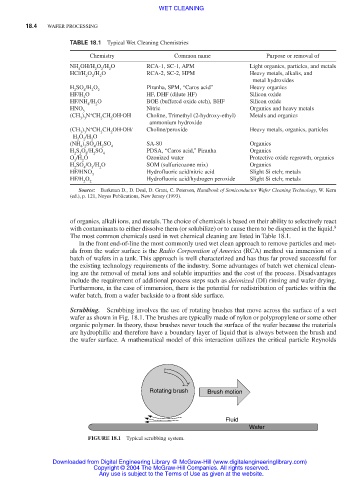
                               Scrubbing.  Scrubbing involves the use of rotating brushes that move across the surface of a wet
                               wafer as shown in Fig. 18.1. The brushes are typically made of nylon or polypropylene or some other
                               organic polymer. In theory, these brushes never touch the surface of the wafer because the materials
                               are hydrophilic and therefore have a boundary layer of liquid that is always between the brush and
                               the wafer surface. A mathematical model of this interaction utilizes the critical particle Reynolds


                                                    Rotating brush  Brush motion


                                                                         Fluid
                                                                               Wafer
                                    FIGURE 18.1  Typical scrubbing system.


                          Downloaded from Digital Engineering Library @ McGraw-Hill (www.digitalengineeringlibrary.com)
                                     Copyright © 2004 The McGraw-Hill Companies. All rights reserved.
                                       Any use is subject to the Terms of Use as given at the website.

