


Page 270 - Semiconductor Manufacturing Handbook
P. 270
Geng(SMH)_CH18.qxd  04/04/2005  19:58  Page 18.11


                                                          WET CLEANING

                                                                                         WET CLEANING  18.11


                                                        Film 2
                                                        Film 2
                                                        Film 1
                                                        Film 1
                                                          Si Si


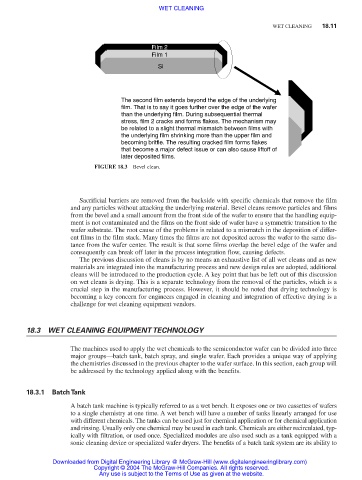
                                                The second film extends beyond the edge of the underlying
                                                film. That is to say it goes further over the edge of the wafer
                                                than the underlying film. During subsequential thermal
                                                stress, film 2 cracks and forms flakes. The mechanism may
                                                be related to a slight thermal mismatch between films with
                                                the underlying film shrinking more than the upper film and
                                                becoming brittle. The resulting cracked film forms flakes
                                                that become a major defect issue or can also cause liftoff of
                                                later deposited films.
                                         FIGURE 18.3  Bevel clean.


                                    Sacrificial barriers are removed from the backside with specific chemicals that remove the film
                                  and any particles without attacking the underlying material. Bevel cleans remove particles and films
                                  from the bevel and a small amount from the front side of the wafer to ensure that the handling equip-
                                  ment is not contaminated and the films on the front side of wafer have a symmetric transition to the
                                  wafer substrate. The root cause of the problems is related to a mismatch in the deposition of differ-
                                  ent films in the film stack. Many times the films are not deposited across the wafer to the same dis-
                                  tance from the wafer center. The result is that some films overlap the bevel edge of the wafer and
                                  consequently can break off later in the process integration flow, causing defects.
                                    The previous discussion of cleans is by no means an exhaustive list of all wet cleans and as new
                                  materials are integrated into the manufacturing process and new design rules are adopted, additional
                                  cleans will be introduced to the production cycle. A key point that has be left out of this discussion
                                  on wet cleans is drying. This is a separate technology from the removal of the particles, which is a
                                  crucial step in the manufacturing process. However, it should be noted that drying technology is
                                  becoming a key concern for engineers engaged in cleaning and integration of effective drying is a
                                  challenge for wet cleaning equipment vendors.


                      18.3 WET CLEANING EQUIPMENT TECHNOLOGY

                                  The machines used to apply the wet chemicals to the semiconductor wafer can be divided into three
                                  major groups—batch tank, batch spray, and single wafer. Each provides a unique way of applying
                                  the chemistries discussed in the previous chapter to the wafer surface. In this section, each group will
                                  be addressed by the technology applied along with the benefits.


                      18.3.1  Batch Tank
                                  A batch tank machine is typically referred to as a wet bench. It exposes one or two cassettes of wafers
                                  to a single chemistry at one time. A wet bench will have a number of tanks linearly arranged for use
                                  with different chemicals. The tanks can be used just for chemical application or for chemical application
                                  and rinsing. Usually only one chemical may be used in each tank. Chemicals are either recirculated, typ-
                                  ically with filtration, or used once. Specialized modules are also used such as a tank equipped with a
                                  sonic cleaning device or specialized wafer dryers. The benefits of a batch tank system are its ability to

                             Downloaded from Digital Engineering Library @ McGraw-Hill (www.digitalengineeringlibrary.com)
                                        Copyright © 2004 The McGraw-Hill Companies. All rights reserved.
                                          Any use is subject to the Terms of Use as given at the website.

