


Page 272 - Semiconductor Manufacturing Handbook
P. 272
Geng(SMH)_CH18.qxd  04/04/2005  19:58  Page 18.13


                                                          WET CLEANING

                                                                                         WET CLEANING  18.13


                                                                                                Silicon
                                                                                                Oxide
                                                                                               Poly
                                                                                               Oxide
                                                                                               Nitride


                                                                                  Warped
                                                                                  wafer         Particle

                                                                                        ∆ DOF
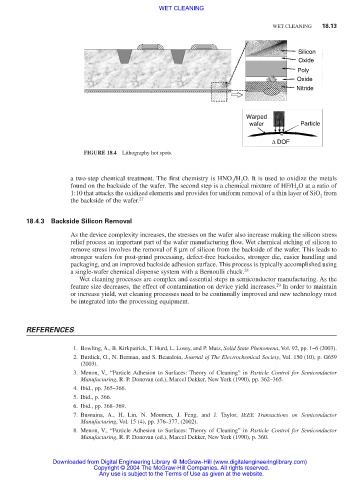
                                      FIGURE 18.4  Lithography hot spots.


                                  a two-step chemical treatment. The first chemistry is HNO /H O. It is used to oxidize the metals
                                                                              3  2
                                  found on the backside of the wafer. The second step is a chemical mixture of HF/H O at a ratio of
                                                                                               2
                                  1:10 that attacks the oxidized elements and provides for uniform removal of a thin layer of SiO from
                                                                                                      2
                                  the backside of the wafer. 27
                      18.4.3 Backside Silicon Removal

                                  As the device complexity increases, the stresses on the wafer also increase making the silicon stress
                                  relief process an important part of the wafer manufacturing flow. Wet chemical etching of silicon to
                                  remove stress involves the removal of 8 µm of silicon from the backside of the wafer. This leads to
                                  stronger wafers for post-grind processing, defect-free backsides, stronger die, easier handling and
                                  packaging, and an improved backside adhesion surface. This process is typically accomplished using
                                  a single-wafer chemical dispense system with a Bernoulli chuck. 28
                                    Wet cleaning processes are complex and essential steps in semiconductor manufacturing. As the
                                                                                          29
                                  feature size decreases, the effect of contamination on device yield increases. In order to maintain
                                  or increase yield, wet cleaning processes need to be continually improved and new technology must
                                  be integrated into the processing equipment.


                      REFERENCES

                                   1. Bowling, A., B. Kirkpatrick, T. Hurd, L. Losey, and P. Matz, Solid State Phenomena, Vol. 92, pp. 1–6 (2003).
                                   2. Burdick, G., N. Berman, and S. Beaudoin, Journal of The Electrochemical Society, Vol. 150 (10), p. G659
                                     (2003).
                                   3. Menon, V., “Particle Adhesion to Surfaces:  Theory of Cleaning” in  Particle Control for Semiconductor
                                     Manufacturing, R. P. Donovan (ed.), Marcel Dekker, New York (1990), pp. 362–365.
                                   4. Ibid., pp. 365–366.
                                   5. Ibid., p. 366.
                                   6. Ibid., pp. 368–369.
                                   7. Busnaina,  A., H. Lin, N. Moumen, J. Feng, and J.  Taylor,  IEEE  Transactions on Semiconductor
                                     Manufacturing, Vol. 15 (4), pp. 376–377, (2002).
                                   8. Menon, V., “Particle Adhesion to Surfaces:  Theory of Cleaning” in  Particle Control for Semiconductor
                                     Manufacturing, R. P. Donovan (ed.), Marcel Dekker, New York (1990), p. 360.


                             Downloaded from Digital Engineering Library @ McGraw-Hill (www.digitalengineeringlibrary.com)
                                        Copyright © 2004 The McGraw-Hill Companies. All rights reserved.
                                          Any use is subject to the Terms of Use as given at the website.

