


Page 303 - Semiconductor Manufacturing Handbook
P. 303
Geng(SMH)_CH19.qxd  04/04/2005  20:00  Page 19.30


                                                INSPECTION, MEASUREMENT, AND TEST

                   19.30  FINAL MANUFACTURING

                               Using orthogonal frequency division multiplexing (OFDM) as an example, these calculations are
                               made for each burst and data vector, resulting in an individual EVM (the error vector for a particu-
                               lar instant in time relative to the symbol clock).
                                 Adjacent channel power.  When two or more signals (f1 and f2) at different frequencies are
                               applied to an amplifier, nonlinearities in the amplifier cause the output to contain additional mixing
                               frequencies called intermodulation (IM) products. These occur at frequencies (mf1 ± nf2) and at
                               (mf2 ± nf1), where m + n is the order of the IM product. For example, the second order IM products
                               would be at f1 + f2, f1 − f2 and f2 − f1. Even-order products are located near the baseband, while
                               odd-order products are located on either side of the input signals. As an example, if two input tones
                               are applied to the input of the amplifier, the output consists of amplified versions of the two input
                               tones, plus odd-order intermodulation products caused by amplifier nonlinearity.
                                 If the frequency spectrum is divided into channels of equal bandwidth located next to each other, and
                               the two input tones are applied, distortion in the amplifier causes signals to appear in the output adjacent
                               channels. In the digital-modulation world, the two tones at the input are really replaced by an infinite num-
                               ber of tones (or noise) within the defined channel bandwidth. The energy generated by amplifier nonlin-
                               earity in adjacent channels is called spectral regrowth and is measured as adjacent channel leakage.
                                 The actual specifications take the measured spectral regrowth within a specified bandwidth and
                               ratio it as a relative quantity to the desired power in the main channel. This is done for each of the
                               two adjacent channels above and below the desired transmit channel, expressed in dB and is called
                               adjacent channel leakage ratio (ACLR).
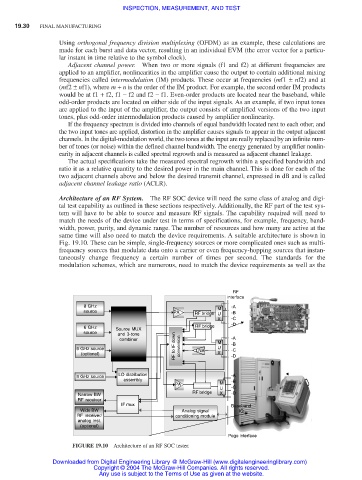
                               Architecture of an RF System.  The RF SOC device will need the same class of analog and digi-
                               tal test capability as outlined in these sections respectively. Additionally, the RF part of the test sys-
                               tem will have to be able to source and measure RF signals. The capability required will need to
                               match the needs of the device under test in terms of specifications, for example, frequency, band-
                               width, power, purity, and dynamic range. The number of resources and how many are active at the
                               same time will also need to match the device requirements. A suitable architecture is shown in
                               Fig. 19.10. These can be simple, single-frequency sources or more complicated ones such as multi-
                               frequency sources that modulate data onto a carrier or even frequency-hopping sources that instan-
                               taneously change frequency a certain number of times per second.  The standards for the
                               modulation schemes, which are numerous, need to match the device requirements as well as the


                                                                              RF
                                                                            interface
                                      8 GHz                                   -A
                                      source                  PA    RF bridge U M  -B
                                                                          X   -C
                                                                              -D
                                      6 GHz   Source MUX            RF bridge
                                      source
                                               and 3-tone
                                               combiner                   M   -A
                                    6 GHz source              RF to IF down  conversion  LNA  U  -B
                                                                              -C
                                     (optional)                           X   -D
                                               LO distribution                -A
                                    8 GHz source
                                                assembly                      -B
                                                               PA
                                                              PA          M
                                                                          U   -C
                                                                   RF bridge  X  -D
                                    Narrow BW
                                    RF receiver
                                                IF mux                        Baseband
                                     Wide BW                    Analog signal   IQ
                                    RF receiver/              conditioning module
                                    analog inst.
                                     (optional)
                                                                             Pogo interface
                                   FIGURE 19.10  Architecture of an RF SOC tester.
                             Downloaded from Digital Engineering Library @ McGraw-Hill (www.digitalengineeringlibrary.com)
                                        Copyright © 2004 The McGraw-Hill Companies. All rights reserved.
                                          Any use is subject to the Terms of Use as given at the website.

