


Page 299 - Semiconductor Manufacturing Handbook
P. 299
Geng(SMH)_CH19.qxd  04/04/2005  20:00  Page 19.26


                                                INSPECTION, MEASUREMENT, AND TEST

                   19.26  FINAL MANUFACTURING

                                 Most system-on-chip (SOC) devices include PLL sections to generate appropriate clock signals
                               to be distributed to various functional blocks. An external oscillator may supply a basic clock signal
                               to the device and it may be multiplied or divided into suitable frequencies for each functional block.
                               In a serial data transmission SOC, an incoming receiver signal may contain its own clock that is
                               extracted by a PLL.
                                 The power section is one of the most critical sections of the device that is frequently overlooked.
                               Optimum power supply, distribution, and bypass filtering are key to keeping noise and ripple to a
                               minimum to allow the device to function properly.
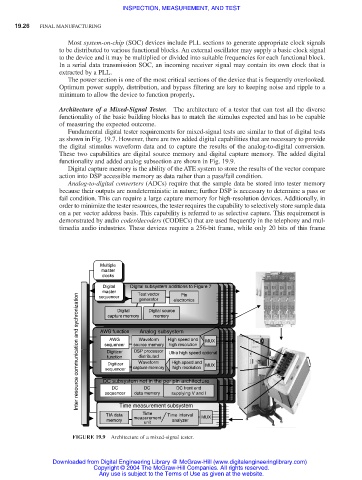
                               Architecture of a Mixed-Signal Tester.  The architecture of a tester that can test all the diverse
                               functionality of the basic building blocks has to match the stimulus expected and has to be capable
                               of measuring the expected outcome.
                                 Fundamental digital tester requirements for mixed-signal tests are similar to that of digital tests
                               as shown in Fig. 19.7. However, there are two added digital capabilities that are necessary to provide
                               the digital stimulus waveform data and to capture the results of the analog-to-digital conversion.
                               These two capabilities are digital source memory and digital capture memory. The added digital
                               functionality and added analog subsection are shown in Fig. 19.9.
                                 Digital capture memory is the ability of the ATE system to store the results of the vector compare
                               action into DSP accessible memory as data rather than a pass/fail condition.
                                 Analog-to-digital converters (ADCs) require that the sample data be stored into tester memory
                               because their outputs are nondeterministic in nature; further DSP is necessary to determine a pass or
                               fail condition. This can require a large capture memory for high-resolution devices. Additionally, in
                               order to minimize the tester resources, the tester requires the capability to selectively store sample data
                               on a per vector address basis. This capability is referred to as selective capture. This requirement is
                               demonstrated by audio coder/decoders (CODECs) that are used frequently in the telephony and mul-
                               timedia audio industries. These devices require a 256-bit frame, while only 20 bits of this frame


                                          Multiple
                                          master
                                           clocks
                                           Digital  Digital subsystem additions to Figure 7
                                           master  Digital  Test vector  electronics
                                    Inter resource communication and sychronization  AWG function  capture memory  High speed and  MUX
                                                                Pin
                                          sequencer
                                                     generator
                                                       Digital source
                                            capture memory
                                                        memory
                                                     Analog subsystem
                                                    Waveform
                                             AWG
                                                             high resolution
                                           sequencer
                                                   source memory
                                                   DSP processor
                                            Digitizer
                                                             Ultra high speed optional
                                                    distributed
                                            function
                                                             High speed and
                                                    Waveform
                                            Digitizer
                                                                      MUX
                                                              high resolution
                                           sequencer
                                           DC subsystem not in the per pin architecture
                                                      DC
                                                               DC front end
                                             DC
                                                   data memory
                                           sequencer
                                               Time measurement subsystem
                                                      Time   supplying V and I
                                            TIA data  measurement  Time interval  MUX
                                            memory           analyzer
                                                      unit
                                   FIGURE 19.9  Architecture of a mixed-signal tester.
                             Downloaded from Digital Engineering Library @ McGraw-Hill (www.digitalengineeringlibrary.com)
                                        Copyright © 2004 The McGraw-Hill Companies. All rights reserved.
                                          Any use is subject to the Terms of Use as given at the website.

