


Page 296 - Semiconductor Manufacturing Handbook
P. 296
Geng(SMH)_CH19.qxd  04/04/2005  20:00  Page 19.23


                                                INSPECTION, MEASUREMENT, AND TEST

                                                                        INSPECTION, MEASUREMENT, AND TEST  19.23


                                       PC workstation
                                      controls all sites
                                                      PPS
                                                      PMU
                                                      PPMU
                                                                                  DUT
                                                     Vector                       DUT Site x
                                                                    M            DUT
                                                     memory                     DUT
                                                                    U
                                                                    X
                                                     Algorithmic                   Site 1
                                                      pattern
                                            Test
                                                     generator
                                            site              M
                                          controller          U
                                                     Buffer   X
                                                     memory
                                                      Error
                                                      catch
                                                      RAM
                                                                                Site x
                                                                              Site 1
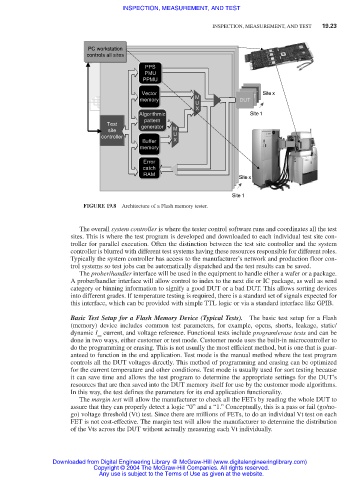
                                      FIGURE 19.8  Architecture of a Flash memory tester.

                                    The overall system controller is where the tester control software runs and coordinates all the test
                                  sites. This is where the test program is developed and downloaded to each individual test site con-
                                  troller for parallel execution. Often the distinction between the test site controller and the system
                                  controller is blurred with different test systems having these resources responsible for different roles.
                                  Typically the system controller has access to the manufacturer’s network and production floor con-
                                  trol systems so test jobs can be automatically dispatched and the test results can be saved.
                                    The prober/handler interface will be used in the equipment to handle either a wafer or a package.
                                  A prober/handler interface will allow control to index to the next die or IC package, as well as send
                                  category or binning information to signify a good DUT or a bad DUT. This allows sorting devices
                                  into different grades. If temperature testing is required, there is a standard set of signals expected for
                                  this interface, which can be provided with simple TTL logic or via a standard interface like GPIB.

                                  Basic Test Setup for a Flash Memory Device (Typical Tests).  The basic test setup for a Flash
                                  (memory) device includes common test parameters, for example, opens, shorts, leakage, static/
                                  dynamic I current, and voltage reference. Functional tests include program/erase tests and can be
                                         cc
                                  done in two ways, either customer or test mode. Customer mode uses the built-in microcontroller to
                                  do the programming or erasing. This is not usually the most efficient method, but is one that is guar-
                                  anteed to function in the end application. Test mode is the manual method where the test program
                                  controls all the DUT voltages directly. This method of programming and erasing can be optimized
                                  for the current temperature and other conditions. Test mode is usually used for sort testing because
                                  it can save time and allows the test program to determine the appropriate settings for the DUT’s
                                  resources that are then saved into the DUT memory itself for use by the customer mode algorithms.
                                  In this way, the test defines the parameters for its end application functionality.
                                    The margin test will allow the manufacturer to check all the FETs by reading the whole DUT to
                                  assure that they can properly detect a logic “0” and a “1.” Conceptually, this is a pass or fail (go/no-
                                  go) voltage threshold (Vt) test. Since there are millions of FETs, to do an individual Vt test on each
                                  FET is not cost-effective. The margin test will allow the manufacturer to determine the distribution
                                  of the Vts across the DUT without actually measuring each Vt individually.


                             Downloaded from Digital Engineering Library @ McGraw-Hill (www.digitalengineeringlibrary.com)
                                        Copyright © 2004 The McGraw-Hill Companies. All rights reserved.
                                          Any use is subject to the Terms of Use as given at the website.

