


Page 291 - Semiconductor Manufacturing Handbook
P. 291
Geng(SMH)_CH19.qxd  04/04/2005  20:00  Page 19.18


                                                INSPECTION, MEASUREMENT, AND TEST

                   19.18  FINAL MANUFACTURING

                                 Shmoo plots depict two or three of these sweep parameters tested across a range for each, and the
                               pass/fail results plotted in an XY(Z) plot. This not only shows the limits of the parameters, but also
                               indicates how the parameters interact with one another.
                               Architecture of a Digital Tester.  Digital tester architectures can vary widely, depending on the tar-
                               get market of devices to cover. Some digital testers are aimed at specific test market segments, such
                               as DFT or low-end production; other digital testers have a scalable platform, allowing changes in
                               speed and memory depth to enable the end-user to expand the system as needs arise or to reconfig-
                               ure systems for a particular job without having to invest in different platforms, DUT boards or test
                               program translations.
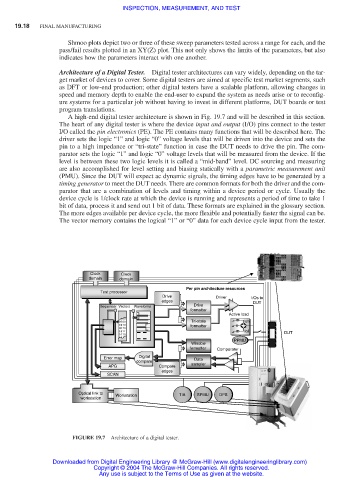
                                 A high-end digital tester architecture is shown in Fig. 19.7 and will be described in this section.
                               The heart of any digital tester is where the device input and output (I/O) pins connect to the tester
                               I/O called the pin electronics (PE). The PE contains many functions that will be described here. The
                               driver sets the logic “1” and logic “0” voltage levels that will be driven into the device and sets the
                               pin to a high impedance or “tri-state” function in case the DUT needs to drive the pin. The com-
                               parator sets the logic “1” and logic “0” voltage levels that will be measured from the device. If the
                               level is between these two logic levels it is called a “mid-band” level. DC sourcing and measuring
                               are also accomplished for level setting and biasing statically with a parametric measurement unit
                               (PMU). Since the DUT will expect ac dynamic signals, the timing edges have to be generated by a
                               timing generator to meet the DUT needs. There are common formats for both the driver and the com-
                               parator that are a combination of levels and timing within a device period or cycle. Usually the
                               device cycle is 1/clock rate at which the device is running and represents a period of time to take 1
                               bit of data, process it and send out 1 bit of data. These formats are explained in the glossary section.
                               The more edges available per device cycle, the more flexible and potentially faster the signal can be.
                               The vector memory contains the logical “1” or “0” data for each device cycle input from the tester.


                                       Clock    Clock
                                       domain  domain
                                                                 Per pin architecture resources
                                          Test processor
                                                           Drive         Driver    I/Os to
                                                           edges                   DUT
                                                                   Drive
                                          Sequencer Vectors  Waveforms
                                                                  formatter
                                                                             Active load
                                               0
                                               0 000
                                               0 000               Tri-state     Ioh
                                               0 0 10             formatter
                                               000 1                   r
                                               0011                              Iol        DUT
                                               0110
                                               0010
                                                                              PPMU
                                                                   Window
                                                                  formatter   Comparator
                                           Error map  Digital      Data
                                                    compare
                                            APG           Compare  sampler
                                                           edges
                                            SCAN
                                    Optical link to  Workstation  TIA  SPMU  DPS
                                     workstation
                                   FIGURE 19.7  Architecture of a digital tester.

                             Downloaded from Digital Engineering Library @ McGraw-Hill (www.digitalengineeringlibrary.com)
                                        Copyright © 2004 The McGraw-Hill Companies. All rights reserved.
                                          Any use is subject to the Terms of Use as given at the website.

