


Page 239 - Separation process engineering
P. 239
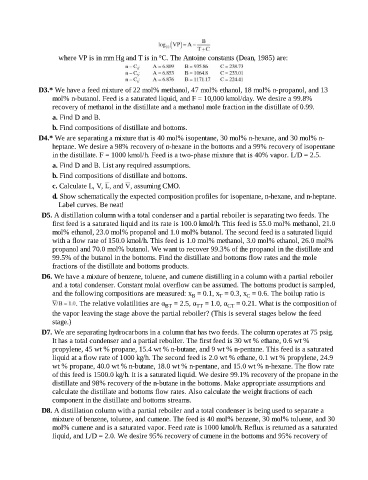
where VP is in mm Hg and T is in °C. The Antoine constants (Dean, 1985) are:


                       D3.* We have a feed mixture of 22 mol% methanol, 47 mol% ethanol, 18 mol% n-propanol, and 13
                             mol% n-butanol. Feed is a saturated liquid, and F = 10,000 kmol/day. We desire a 99.8%
                             recovery of methanol in the distillate and a methanol mole fraction in the distillate of 0.99.

                             a. Find D and B.
                             b. Find compositions of distillate and bottoms.

                       D4.* We are separating a mixture that is 40 mol% isopentane, 30 mol% n-hexane, and 30 mol% n-
                             heptane. We desire a 98% recovery of n-hexane in the bottoms and a 99% recovery of isopentane
                             in the distillate. F = 1000 kmol/h. Feed is a two-phase mixture that is 40% vapor. L/D = 2.5.

                             a. Find D and B. List any required assumptions.
                             b. Find compositions of distillate and bottoms.

                             c. Calculate L, V,  , and  , assuming CMO.
                             d. Show schematically the expected composition profiles for isopentane, n-hexane, and n-heptane.
                               Label curves. Be neat!

                        D5. A distillation column with a total condenser and a partial reboiler is separating two feeds. The
                             first feed is a saturated liquid and its rate is 100.0 kmol/h. This feed is 55.0 mol% methanol, 21.0
                             mol% ethanol, 23.0 mol% propanol and 1.0 mol% butanol. The second feed is a saturated liquid
                             with a flow rate of 150.0 kmol/h. This feed is 1.0 mol% methanol, 3.0 mol% ethanol, 26.0 mol%
                             propanol and 70.0 mol% butanol. We want to recover 99.3% of the propanol in the distillate and
                             99.5% of the butanol in the bottoms. Find the distillate and bottoms flow rates and the mole
                             fractions of the distillate and bottoms products.

                        D6. We have a mixture of benzene, toluene, and cumene distilling in a column with a partial reboiler
                             and a total condenser. Constant molal overflow can be assumed. The bottoms product is sampled,
                             and the following compositions are measured: x  = 0.1, x  = 0.3, x  = 0.6. The boilup ratio is
                                                                                              T
                                                                                                         C
                                                                                   B
                                      . The relative volatilities are α  = 2.5, α  = 1.0, α  = 0.21. What is the composition of
                                                                                     TT
                                                                         BT
                                                                                                 CT
                             the vapor leaving the stage above the partial reboiler? (This is several stages below the feed
                             stage.)
                        D7. We are separating hydrocarbons in a column that has two feeds. The column operates at 75 psig.
                             It has a total condenser and a partial reboiler. The first feed is 30 wt % ethane, 0.6 wt %
                             propylene, 45 wt % propane, 15.4 wt % n-butane, and 9 wt % n-pentane. This feed is a saturated
                             liquid at a flow rate of 1000 kg/h. The second feed is 2.0 wt % ethane, 0.1 wt % propylene, 24.9

                             wt % propane, 40.0 wt % n-butane, 18.0 wt % n-pentane, and 15.0 wt % n-hexane. The flow rate
                             of this feed is 1500.0 kg/h. It is a saturated liquid. We desire 99.1% recovery of the propane in the
                             distillate and 98% recovery of the n-butane in the bottoms. Make appropriate assumptions and
                             calculate the distillate and bottoms flow rates. Also calculate the weight fractions of each
                             component in the distillate and bottoms streams.
                        D8. A distillation column with a partial reboiler and a total condenser is being used to separate a

                             mixture of benzene, toluene, and cumene. The feed is 40 mol% benzene, 30 mol% toluene, and 30
                             mol% cumene and is a saturated vapor. Feed rate is 1000 kmol/h. Reflux is returned as a saturated
                             liquid, and L/D = 2.0. We desire 95% recovery of cumene in the bottoms and 95% recovery of

