


Page 235 - Separation process engineering
P. 235
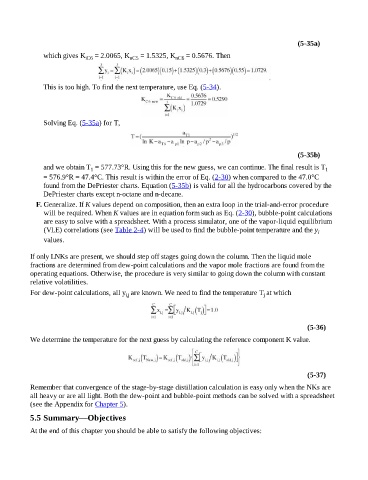
(5-35a)

                         which gives K  = 2.0065, K        nC5  = 1.5325, K  nC6  = 0.5676. Then
                                          iC6


                         This is too high. To find the next temperature, use Eq. (5-34).


                         Solving Eq. (5-35a) for T,


                                                                                                                             (5-35b)

                         and we obtain T  = 577.73°R. Using this for the new guess, we can continue. The final result is T
                                            1                                                                                          1
                         = 576.9°R = 47.4°C. This result is within the error of Eq. (2-30) when compared to the 47.0°C

                         found from the DePriester charts. Equation (5-35b) is valid for all the hydrocarbons covered by the
                         DePriester charts except n-octane and n-decane.
                      F. Generalize. If K values depend on composition, then an extra loop in the trial-and-error procedure
                         will be required. When K values are in equation form such as Eq. (2-30), bubble-point calculations
                         are easy to solve with a spreadsheet. With a process simulator, one of the vapor-liquid equilibrium
                         (VLE) correlations (see Table 2-4) will be used to find the bubble-point temperature and the y             i

                         values.


                    If only LNKs are present, we should step off stages going down the column. Then the liquid mole
                    fractions are determined from dew-point calculations and the vapor mole fractions are found from the
                    operating equations. Otherwise, the procedure is very similar to going down the column with constant
                    relative volatilities.

                    For dew-point calculations, all y  are known. We need to find the temperature T at which
                                                         i,j
                                                                                                               j


                                                                                                                                (5-36)

                    We determine the temperature for the next guess by calculating the reference component K value.


                                                                                                                                (5-37)

                    Remember that convergence of the stage-by-stage distillation calculation is easy only when the NKs are
                    all heavy or are all light. Both the dew-point and bubble-point methods can be solved with a spreadsheet
                    (see the Appendix for Chapter 5).

                    5.5 Summary—Objectives

                    At the end of this chapter you should be able to satisfy the following objectives:

