


Page 231 - Separation process engineering
P. 231
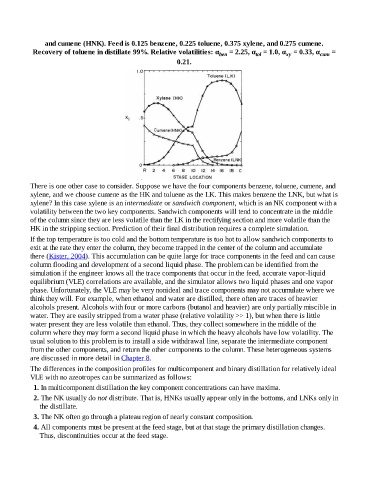
and cumene (HNK). Feed is 0.125 benzene, 0.225 toluene, 0.375 xylene, and 0.275 cumene.
                     Recovery of toluene in distillate 99%. Relative volatilities: α          ben  = 2.25, α  = 1.0, α  = 0.33, α    cum  =
                                                                                                            tol
                                                                                                                        xy
                                                                             0.21.


                    There is one other case to consider. Suppose we have the four components benzene, toluene, cumene, and
                    xylene, and we choose cumene as the HK and toluene as the LK. This makes benzene the LNK, but what is
                    xylene? In this case xylene is an intermediate or sandwich component, which is an NK component with a
                    volatility between the two key components. Sandwich components will tend to concentrate in the middle
                    of the column since they are less volatile than the LK in the rectifying section and more volatile than the
                    HK in the stripping section. Prediction of their final distribution requires a complete simulation.

                    If the top temperature is too cold and the bottom temperature is too hot to allow sandwich components to
                    exit at the rate they enter the column, they become trapped in the center of the column and accumulate
                    there (Kister, 2004). This accumulation can be quite large for trace components in the feed and can cause
                    column flooding and development of a second liquid phase. The problem can be identified from the
                    simulation if the engineer knows all the trace components that occur in the feed, accurate vapor-liquid
                    equilibrium (VLE) correlations are available, and the simulator allows two liquid phases and one vapor
                    phase. Unfortunately, the VLE may be very nonideal and trace components may not accumulate where we
                    think they will. For example, when ethanol and water are distilled, there often are traces of heavier
                    alcohols present. Alcohols with four or more carbons (butanol and heavier) are only partially miscible in
                    water. They are easily stripped from a water phase (relative volatility >> 1), but when there is little
                    water present they are less volatile than ethanol. Thus, they collect somewhere in the middle of the
                    column where they may form a second liquid phase in which the heavy alcohols have low volatility. The
                    usual solution to this problem is to install a side withdrawal line, separate the intermediate component
                    from the other components, and return the other components to the column. These heterogeneous systems

                    are discussed in more detail in Chapter 8.
                    The differences in the composition profiles for multicomponent and binary distillation for relatively ideal
                    VLE with no azeotropes can be summarized as follows:

                     1. In multicomponent distillation the key component concentrations can have maxima.
                     2. The NK usually do not distribute. That is, HNKs usually appear only in the bottoms, and LNKs only in
                        the distillate.

                     3. The NK often go through a plateau region of nearly constant composition.
                     4. All components must be present at the feed stage, but at that stage the primary distillation changes.

                        Thus, discontinuities occur at the feed stage.

