


Page 226 - Separation process engineering
P. 226
stepping off stages with equilibrium Eq. (5-22) to calculate x  in equilibrium with vapor of composition
                                                                                         i,1
                    y . Then we determine y  for each component from operating Eq. (5-23). Equilibrium Eq. (5-22) is used
                     i,1
                                                i,2
                    to find x  from values y , and so on. Stepping off stages down the column we calculate y  from Eq. (5-
                             i,2
                                                                                                                          i,f
                                               i,2
                    23), x  from Eq. (5-22) with y  = y , and y      i,f+1  from Eq. (5-24) with x  = x , where f is the specified
                                                            i,f
                                                                                                    i,j
                                                                                                         i,f
                                                       i,j
                           i,f
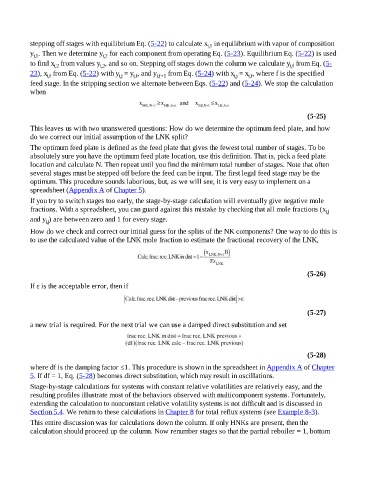
                    feed stage. In the stripping section we alternate between Eqs. (5-22) and (5-24). We stop the calculation
                    when
                                                                                                                                (5-25)

                    This leaves us with two unanswered questions: How do we determine the optimum feed plate, and how
                    do we correct our initial assumption of the LNK split?
                    The optimum feed plate is defined as the feed plate that gives the fewest total number of stages. To be
                    absolutely sure you have the optimum feed plate location, use this definition. That is, pick a feed plate
                    location and calculate N. Then repeat until you find the minimum total number of stages. Note that often

                    several stages must be stepped off before the feed can be input. The first legal feed stage may be the
                    optimum. This procedure sounds laborious, but, as we will see, it is very easy to implement on a
                    spreadsheet (Appendix A of Chapter 5).
                    If you try to switch stages too early, the stage-by-stage calculation will eventually give negative mole
                    fractions. With a spreadsheet, you can guard against this mistake by checking that all mole fractions (x            i,j

                    and y ) are between zero and 1 for every stage.
                          i,j
                    How do we check and correct our initial guess for the splits of the NK components? One way to do this is
                    to use the calculated value of the LNK mole fraction to estimate the fractional recovery of the LNK,


                                                                                                                                (5-26)

                    If ε is the acceptable error, then if


                                                                                                                                (5-27)
                    a new trial is required. For the next trial we can use a damped direct substitution and set


                                                                                                                                (5-28)

                    where df is the damping factor ≤1. This procedure is shown in the spreadsheet in Appendix A of Chapter
                    5. If df = 1, Eq. (5-28) becomes direct substitution, which may result in oscillations.

                    Stage-by-stage calculations for systems with constant relative volatilities are relatively easy, and the
                    resulting profiles illustrate most of the behaviors observed with multicomponent systems. Fortunately,
                    extending the calculation to nonconstant relative volatility systems is not difficult and is discussed in
                    Section 5.4. We return to these calculations in Chapter 8 for total reflux systems (see Example 8-3).
                    This entire discussion was for calculations down the column. If only HNKs are present, then the
                    calculation should proceed up the column. Now renumber stages so that the partial reboiler = 1, bottom

