


Page 222 - Separation process engineering
P. 222
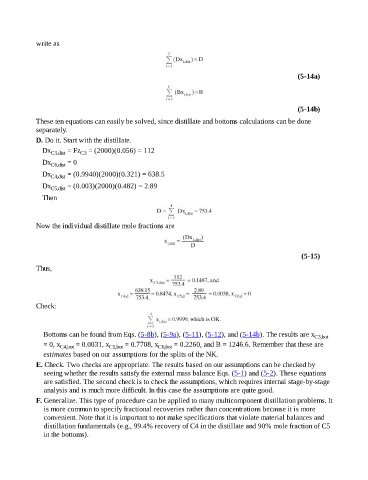
write as


                                                                                                                             (5-14a)


                                                                                                                             (5-14b)

                      These ten equations can easily be solved, since distillate and bottoms calculations can be done
                      separately.

                      D. Do it. Start with the distillate.
                         Dx C3,dist  = Fz  = (2000)(0.056) = 112
                                        C3
                         Dx C6,dist  = 0

                         Dx C4,dist  = (0.9940)(2000)(0.321) = 638.5

                         Dx C5,dist  = (0.003)(2000)(0.482) = 2.89

                         Then


                      Now the individual distillate mole fractions are


                                                                                                                              (5-15)

                      Thus,


                      Check:


                         Bottoms can be found from Eqs. (5-8b), (5-9a), (5-11), (5-12), and (5-14b). The results are x             C3,bot
                         = 0, x C4,bot  = 0.0031, x C5,bot  = 0.7708, x C6,bot  = 0.2260, and B = 1246.6. Remember that these are

                         estimates based on our assumptions for the splits of the NK.
                      E. Check. Two checks are appropriate. The results based on our assumptions can be checked by
                         seeing whether the results satisfy the external mass balance Eqs. (5-1) and (5-2). These equations
                         are satisfied. The second check is to check the assumptions, which requires internal stage-by-stage
                         analysis and is much more difficult. In this case the assumptions are quite good.

                      F. Generalize. This type of procedure can be applied to many multicomponent distillation problems. It
                         is more common to specify fractional recoveries rather than concentrations because it is more
                         convenient. Note that it is important to not make specifications that violate material balances and
                         distillation fundamentals (e.g., 99.4% recovery of C4 in the distillate and 90% mole fraction of C5
                         in the bottoms).

