


Page 223 - Separation process engineering
P. 223
Surprisingly, the ability to do reasonably accurate external mass balances on the basis of a first guess
                    does not guarantee that internal stage-by-stage calculations will be accurate. The problem given in
                    Example 5-1 would be very difficult for stage-by-stage calculations. Let us explore why.

                    At the feed stage all components must be present at finite concentrations. If we wish to step off stages
                    from the bottom up, we cannot use x      C3,bot  = 0 because we would not get a nonzero concentration of
                    propane at the feed stage. Thus, x    C3,bot  must be a small but nonzero value. Unfortunately, we don’t know if

                                                                  -7
                                                            -6
                                                      -5
                                                                            -20
                    the correct value should be 10 , 10 , 10 , or 10 . Thus, the percentage error in x            C3,bot  will be large,
                    and it will be difficult to obtain convergence of the trial-and-error problem. If we try to step off stages
                    from the top down, x   C3,dist  is known accurately, but x C6,dist  is not. Thus, when both heavy and LNKs are
                    present, stage-by-stage calculation methods are difficult. Hengstebeck (1961) developed the use of
                    pseudo-components for approximate multicomponent calculations on a McCabe-Thiele diagram. The LK
                    and LNKs are lumped together and the HK and HNKs are lumped together. As we will see in Section 5.3,
                    these results can only be approximate. Other design procedures should be used for accurate results.

                    If there are only LNKs or only HNKs, then an accurate first guess of compositions can be made. Suppose
                    in Example 5-1 that we specified 99.4% recovery of propane in the distillate and 99.7% recovery of n-
                    butane in the bottoms. This makes propane the LK, n-butane the HK, and n-pentane and n-hexane the
                    HNKs. The assumption that all the HNKs appear in the bottoms is an excellent first guess. Then we can
                    calculate the distillate and bottoms compositions from the external mass balances. The composition
                    calculated in the bottoms is quite accurate. Thus, in this case we can step off stages from the bottom
                    upward and be quite confident that the results are accurate. If only LNKs are present, the stage-by-stage
                    calculation should proceed from the top downward.

                    5.2 Stage-By-Stage Calculations for Constant Molal Overflow and Constant

                    Relative Volatility

                    Although computer simulator programs use matrix methods (see Chapter 6), historically stage-by-stage
                    methods were first used for multicomponent distillation. These methods work well if there are no HNK or
                    if there are no LNK, they have an obvious direct relationship to the McCabe-Thiele approach, and they
                    are easy to implement on a spreadsheet or in MATLAB. The stage-by-stage method also has the
                    advantage for design applications that it is a design method. In this section we look at the simplest case—
                    constant relative volatility. In Section 5.4 the method is expanded to include bubble-point or dew-point
                    calculations on every stage for systems that do not have constant relative volatilities.

                    Consider a typical design problem for ternary distillation with an LNK, an LK, and an HK. The feed flow
                    rate, composition, and temperature are specified, as are L /D, saturated liquid reflux, pressure, use of the
                                                                                     0
                    optimum feed stage, and recoveries of the light and heavy keys in distillate and bottoms, respectively. We
                    wish to predict the number of stages required and the separation obtained.

                    To start the calculation, we need to assume the fractional recovery (frac rec.) for the LNK (A) in the
                    distillate. Then

                    Dx       =Fz  (frac rec. A in dist)
                       A,dist    A
                    Bx A,bot  =Fz  (1 – frac rec. A in dist)
                                 A
                    If, for example, (frac rec. A in dist) = 1.0, then x   A,bot  = 0 and Dx A,dist  = Fz . Once the fractional recovery
                                                                                                       A
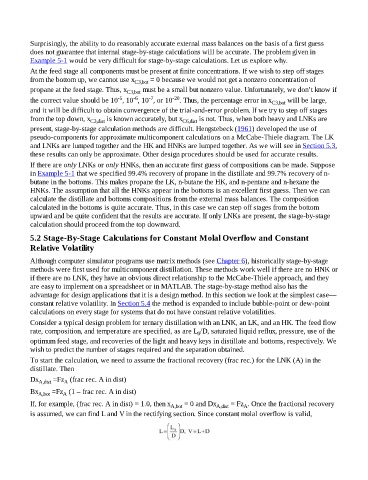
                    is assumed, we can find L and V in the rectifying section. Since constant molal overflow is valid,

