


Page 220 - Separation process engineering
P. 220
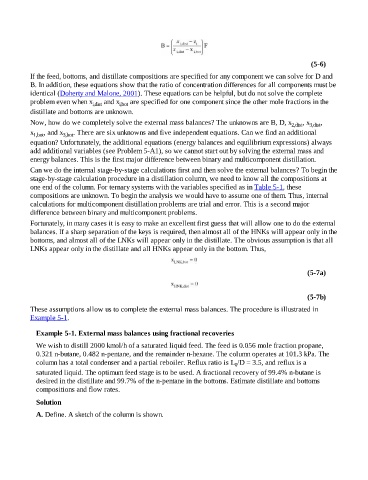
(5-6)

                    If the feed, bottoms, and distillate compositions are specified for any component we can solve for D and
                    B. In addition, these equations show that the ratio of concentration differences for all components must be
                    identical (Doherty and Malone, 2001). These equations can be helpful, but do not solve the complete
                    problem even when x     i,dist  and x i,bot  are specified for one component since the other mole fractions in the

                    distillate and bottoms are unknown.
                    Now, how do we completely solve the external mass balances? The unknowns are B, D, x                  2,dist , x 3,dist ,

                    x 1,bot , and x 3,bot . There are six unknowns and five independent equations. Can we find an additional
                    equation? Unfortunately, the additional equations (energy balances and equilibrium expressions) always
                    add additional variables (see Problem 5-A1), so we cannot start out by solving the external mass and
                    energy balances. This is the first major difference between binary and multicomponent distillation.

                    Can we do the internal stage-by-stage calculations first and then solve the external balances? To begin the
                    stage-by-stage calculation procedure in a distillation column, we need to know all the compositions at
                    one end of the column. For ternary systems with the variables specified as in Table 5-1, these
                    compositions are unknown. To begin the analysis we would have to assume one of them. Thus, internal
                    calculations for multicomponent distillation problems are trial and error. This is a second major
                    difference between binary and multicomponent problems.

                    Fortunately, in many cases it is easy to make an excellent first guess that will allow one to do the external
                    balances. If a sharp separation of the keys is required, then almost all of the HNKs will appear only in the
                    bottoms, and almost all of the LNKs will appear only in the distillate. The obvious assumption is that all
                    LNKs appear only in the distillate and all HNKs appear only in the bottom. Thus,


                                                                                                                                (5-7a)


                                                                                                                                (5-7b)

                    These assumptions allow us to complete the external mass balances. The procedure is illustrated in
                    Example 5-1.


                      Example 5-1. External mass balances using fractional recoveries

                      We wish to distill 2000 kmol/h of a saturated liquid feed. The feed is 0.056 mole fraction propane,
                      0.321 n-butane, 0.482 n-pentane, and the remainder n-hexane. The column operates at 101.3 kPa. The
                      column has a total condenser and a partial reboiler. Reflux ratio is L /D = 3.5, and reflux is a
                                                                                                    0
                      saturated liquid. The optimum feed stage is to be used. A fractional recovery of 99.4% n-butane is
                      desired in the distillate and 99.7% of the n-pentane in the bottoms. Estimate distillate and bottoms
                      compositions and flow rates.

                      Solution

                      A. Define. A sketch of the column is shown.

