


Page 216 - Separation process engineering
P. 216
'   Loop in stripping section stepping off stages with equilibrium
                         and operating eqs.
                         Do
                         If yeq < yint Then
                             Cells(i + 7, 3).Value = "Reflux rate too low"
                             Exit Do
                             End If
                             y = a6 * x ^ 6 + a5 * x ^ 5 + a4 * x ^ 4 + a3 * x ^ 3 + a2 * x
                         ^ 2 + a1 * x + a0

                         '   Record values of stage number, x and y values on spreadsheet.
                             Cells(i + 7, 1).Value = i
                             Cells(i + 7, 2).Value = x
                             Cells(i + 7, 3).Value = y
                             i = i + 1
                             x = (y / LbaroverVbar) + (LbaroverVbar - 1) * xb /
                         LbaroverVbar
                         Loop While i < feedstage
                         '   Calculations in enriching section.
                         Do While y < xd
                         If yeq < yint Then
                             Cells(i + 7, 5).Value = "Reflux rate too low"
                         Exit Do

                         End If
                              y = a6 * x ^ 6 + a5 * x ^ 5 + a4 * x ^ 4 + a3 * x ^ 3 + a2 *
                         x ^ 2 + a1 * x + a0
                         '   Record values of stage number, x, and y on spreadsheet
                             Cells(i + 7, 1).Value = i
                             Cells(i + 7, 2).Value = x
                             Cells(i + 7, 3).Value = y
                             i = i + 1
                             x = (y / LoverV) - (1 - LoverV) * xd / LoverV
                           If x < 0 Then
                             Cells(i + 7, 4).Value = "Feed stage too low"
                           Exit Do
                           End If
                         Loop
                         End Sub


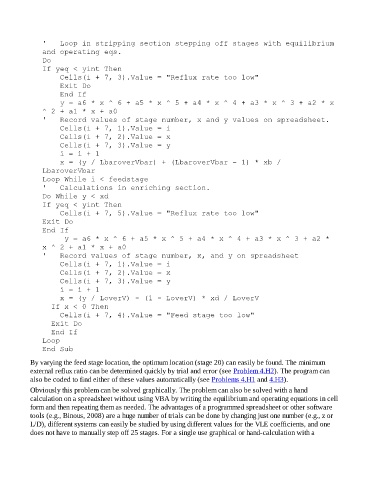
                    By varying the feed stage location, the optimum location (stage 20) can easily be found. The minimum
                    external reflux ratio can be determined quickly by trial and error (see Problem 4.H2). The program can
                    also be coded to find either of these values automatically (see Problems 4.H1 and 4.H3).
                    Obviously this problem can be solved graphically. The problem can also be solved with a hand
                    calculation on a spreadsheet without using VBA by writing the equilibrium and operating equations in cell

                    form and then repeating them as needed. The advantages of a programmed spreadsheet or other software
                    tools (e.g., Binous, 2008) are a huge number of trials can be done by changing just one number (e.g., z or
                    L/D), different systems can easily be studied by using different values for the VLE coefficients, and one
                    does not have to manually step off 25 stages. For a single use graphical or hand-calculation with a

