


Page 213 - Separation process engineering
P. 213
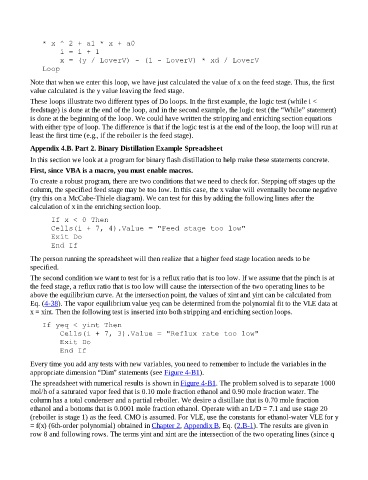
* x ^ 2 + a1 * x + a0
                             i = i + 1
                             x = (y / LoverV) - (1 - LoverV) * xd / LoverV
                         Loop

                    Note that when we enter this loop, we have just calculated the value of x on the feed stage. Thus, the first
                    value calculated is the y value leaving the feed stage.

                    These loops illustrate two different types of Do loops. In the first example, the logic test (while i <
                    feedstage) is done at the end of the loop, and in the second example, the logic test (the “While” statement)
                    is done at the beginning of the loop. We could have written the stripping and enriching section equations
                    with either type of loop. The difference is that if the logic test is at the end of the loop, the loop will run at
                    least the first time (e.g., if the reboiler is the feed stage).


                    Appendix 4.B. Part 2. Binary Distillation Example Spreadsheet
                    In this section we look at a program for binary flash distillation to help make these statements concrete.

                    First, since VBA is a macro, you must enable macros.

                    To create a robust program, there are two conditions that we need to check for. Stepping off stages up the
                    column, the specified feed stage may be too low. In this case, the x value will eventually become negative
                    (try this on a McCabe-Thiele diagram). We can test for this by adding the following lines after the
                    calculation of x in the enriching section loop.

                           If x < 0 Then
                           Cells(i + 7, 4).Value = "Feed stage too low"
                           Exit Do
                           End If

                    The person running the spreadsheet will then realize that a higher feed stage location needs to be
                    specified.

                    The second condition we want to test for is a reflux ratio that is too low. If we assume that the pinch is at
                    the feed stage, a reflux ratio that is too low will cause the intersection of the two operating lines to be
                    above the equilibrium curve. At the intersection point, the values of xint and yint can be calculated from
                    Eq. (4-38). The vapor equilibrium value yeq can be determined from the polynomial fit to the VLE data at
                    x = xint. Then the following test is inserted into both stripping and enriching section loops.


                         If yeq < yint Then
                             Cells(i + 7, 3).Value = "Reflux rate too low"
                             Exit Do
                             End If

                    Every time you add any tests with new variables, you need to remember to include the variables in the
                    appropriate dimension “Dim” statements (see Figure 4-B1).

                    The spreadsheet with numerical results is shown in Figure 4-B1. The problem solved is to separate 1000
                    mol/h of a saturated vapor feed that is 0.10 mole fraction ethanol and 0.90 mole fraction water. The
                    column has a total condenser and a partial reboiler. We desire a distillate that is 0.70 mole fraction
                    ethanol and a bottoms that is 0.0001 mole fraction ethanol. Operate with an L/D = 7.1 and use stage 20
                    (reboiler is stage 1) as the feed. CMO is assumed. For VLE, use the constants for ethanol-water VLE for y
                    = f(x) (6th-order polynomial) obtained in Chapter 2, Appendix B, Eq. (2.B-1). The results are given in
                    row 8 and following rows. The terms yint and xint are the intersection of the two operating lines (since q

