


Page 218 - Separation process engineering
P. 218
Chapter 5. Introduction to Multicomponent Distillation


                    Binary distillation problems can be solved in a straightforward manner using a stage-by-stage calculation
                    that can be done either on a computer or graphically using a McCabe-Thiele diagram. When additional
                    components are added, the resulting multicomponent problem becomes significantly more difficult, and
                    the solution may not be straightforward. In this chapter we will first consider why multicomponent
                    distillation is more complex than binary distillation, and then we will look at the profile shapes typical of
                    multicomponent distillation. In Chapter 6, matrix calculation methods will be applied to multicomponent
                    distillation, and approximate methods will be developed in Chapter 7.


                    5.1 Calculational Difficulties

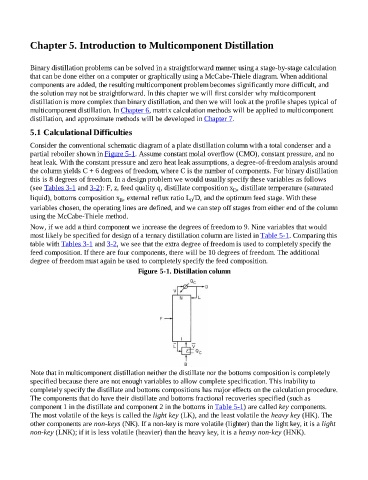
                    Consider the conventional schematic diagram of a plate distillation column with a total condenser and a
                    partial reboiler shown in Figure 5-1. Assume constant molal overflow (CMO), constant pressure, and no
                    heat leak. With the constant pressure and zero heat leak assumptions, a degree-of-freedom analysis around
                    the column yields C + 6 degrees of freedom, where C is the number of components. For binary distillation
                    this is 8 degrees of freedom. In a design problem we would usually specify these variables as follows
                    (see Tables 3-1 and 3-2): F, z, feed quality q, distillate composition x , distillate temperature (saturated
                                                                                                   D
                    liquid), bottoms composition x , external reflux ratio L /D, and the optimum feed stage. With these
                                                       B
                                                                                   0
                    variables chosen, the operating lines are defined, and we can step off stages from either end of the column
                    using the McCabe-Thiele method.

                    Now, if we add a third component we increase the degrees of freedom to 9. Nine variables that would
                    most likely be specified for design of a ternary distillation column are listed in Table 5-1. Comparing this
                    table with Tables 3-1 and 3-2, we see that the extra degree of freedom is used to completely specify the
                    feed composition. If there are four components, there will be 10 degrees of freedom. The additional
                    degree of freedom must again be used to completely specify the feed composition.

                                                              Figure 5-1. Distillation column


                    Note that in multicomponent distillation neither the distillate nor the bottoms composition is completely
                    specified because there are not enough variables to allow complete specification. This inability to
                    completely specify the distillate and bottoms compositions has major effects on the calculation procedure.
                    The components that do have their distillate and bottoms fractional recoveries specified (such as
                    component 1 in the distillate and component 2 in the bottoms in Table 5-1) are called key components.
                    The most volatile of the keys is called the light key (LK), and the least volatile the heavy key (HK). The

                    other components are non-keys (NK). If a non-key is more volatile (lighter) than the light key, it is a light
                    non-key (LNK); if it is less volatile (heavier) than the heavy key, it is a heavy non-key (HNK).

