


Page 230 - Separation process engineering
P. 230
maximum in HK concentration, which peaks at stage 3. Above the feed stage, in stages 11, 12, and 13, the
                    HNK concentration plummets. The major distillation is again between the HK and the HNK. Since the HK
                    is temporarily the more volatile of these components, its concentration increases as we go up the column
                    and peaks at stage 12. After stage 12, there is very little HNK present, and the major distillation is
                    between benzene and toluene. The toluene concentration then decreases as we continue up to the
                    condenser. The secondary maximum above the feed stage is often much smaller than shown in Figure 5-4.
                    The large amounts of cumene in this example cause a larger than normal secondary maximum.

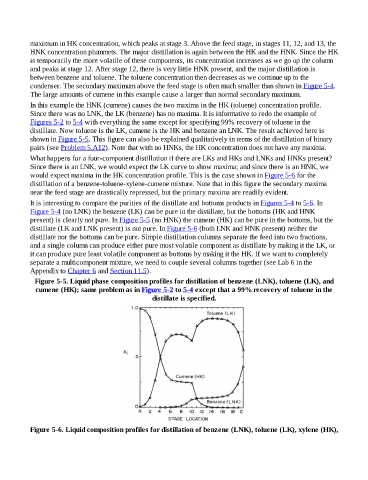
                    In this example the HNK (cumene) causes the two maxima in the HK (toluene) concentration profile.
                    Since there was no LNK, the LK (benzene) has no maxima. It is informative to redo the example of
                    Figures 5-2 to 5-4 with everything the same except for specifying 99% recovery of toluene in the
                    distillate. Now toluene is the LK, cumene is the HK and benzene an LNK. The result achieved here is
                    shown in Figure 5-5. This figure can also be explained qualitatively in terms of the distillation of binary
                    pairs (see Problem 5.A12). Note that with no HNKs, the HK concentration does not have any maxima.

                    What happens for a four-component distillation if there are LKs and HKs and LNKs and HNKs present?
                    Since there is an LNK, we would expect the LK curve to show maxima; and since there is an HNK, we
                    would expect maxima in the HK concentration profile. This is the case shown in Figure 5-6 for the
                    distillation of a benzene-toluene-xylene-cumene mixture. Note that in this figure the secondary maxima
                    near the feed stage are drastically repressed, but the primary maxima are readily evident.

                    It is interesting to compare the purities of the distillate and bottoms products in Figures 5-4 to 5-6. In
                    Figure 5-4 (no LNK) the benzene (LK) can be pure in the distillate, but the bottoms (HK and HNK
                    present) is clearly not pure. In Figure 5-5 (no HNK) the cumene (HK) can be pure in the bottoms, but the
                    distillate (LK and LNK present) is not pure. In Figure 5-6 (both LNK and HNK present) neither the
                    distillate nor the bottoms can be pure. Simple distillation columns separate the feed into two fractions,
                    and a single column can produce either pure most volatile component as distillate by making it the LK, or
                    it can produce pure least volatile component as bottoms by making it the HK. If we want to completely
                    separate a multicomponent mixture, we need to couple several columns together (see Lab 6 in the
                    Appendix to Chapter 6 and Section 11.5).

                      Figure 5-5. Liquid phase composition profiles for distillation of benzene (LNK), toluene (LK), and
                      cumene (HK); same problem as in Figure 5-2 to 5-4 except that a 99% recovery of toluene in the
                                                                    distillate is specified.


                    Figure 5-6. Liquid composition profiles for distillation of benzene (LNK), toluene (LK), xylene (HK),

