


Page 233 - Separation process engineering
P. 233
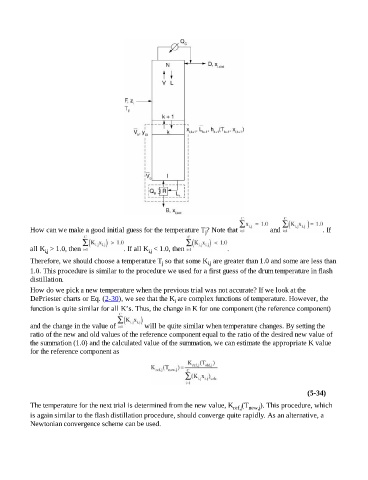
How can we make a good initial guess for the temperature T? Note that                         and                 . If
                                                                                        j


                    all K  > 1.0, then                   . If all K  < 1.0, then                 .
                          i,j
                                                                  i,j
                    Therefore, we should choose a temperature T so that some K  are greater than 1.0 and some are less than
                                                                        j
                                                                                         i,j
                    1.0. This procedure is similar to the procedure we used for a first guess of the drum temperature in flash
                    distillation.

                    How do we pick a new temperature when the previous trial was not accurate? If we look at the
                    DePriester charts or Eq. (2-30), we see that the K are complex functions of temperature. However, the
                                                                            i
                    function is quite similar for all K’s. Thus, the change in K for one component (the reference component)


                    and the change in the value of               will be quite similar when temperature changes. By setting the
                    ratio of the new and old values of the reference component equal to the ratio of the desired new value of
                    the summation (1.0) and the calculated value of the summation, we can estimate the appropriate K value
                    for the reference component as


                                                                                                                                (5-34)

                    The temperature for the next trial is determined from the new value, K         ref,j (T new,j ). This procedure, which
                    is again similar to the flash distillation procedure, should converge quite rapidly. As an alternative, a

                    Newtonian convergence scheme can be used.

