


Page 232 - Separation process engineering
P. 232
Understanding the differences between binary and multicomponent distillation will be helpful when you
                    are doing calculations for multicomponent distillation.

                    5.4 Bubble-Point and Dew-Point Equilibrium Calculations

                    Although convenient mathematically, few systems have constant or almost constant relative volatilities. In
                    this case we need to do a complete equilibrium calculation on each stage. If the distillation has HNKs,

                    HK, and LK, we should step off stages from the bottom up and do a bubble-point calculation on each
                    stage. The bubble-point temperature is the temperature of stage j at which the liquid mixture on the stage
                    begins to boil. The pressure, p , and the mole fractions of the liquid, x , will be known. We wish to find
                                                       j
                                                                                                   i,j
                    the temperature, T, at which Σ y  = 1.0, where the y  are calculated as y  = K (T)x  Stepping off stages
                                                         i,j
                                                                                                      i,j
                                                                                                             i,j
                                                                               i,j
                                         j
                                                                                                                 j i,j.
                    down the column (HK, LK, and LNKs present), we use dew-point calculations with known y  to
                                                                                                                             i,j
                    determine T and x .
                                  j
                                         i,j
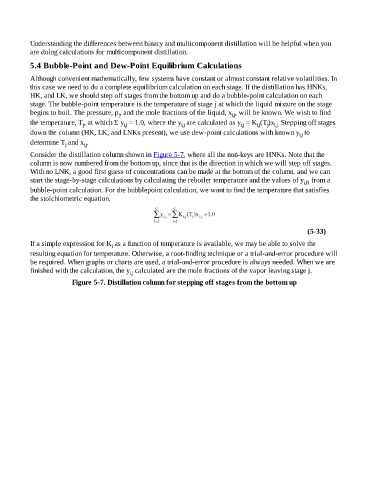
                    Consider the distillation column shown in Figure 5-7, where all the non-keys are HNKs. Note that the
                    column is now numbered from the bottom up, since that is the direction in which we will step off stages.
                    With no LNK, a good first guess of concentrations can be made at the bottom of the column, and we can
                    start the stage-by-stage calculations by calculating the reboiler temperature and the values of y  from a
                                                                                                                               i,R
                    bubble-point calculation. For the bubblepoint calculation, we want to find the temperature that satisfies
                    the stoichiometric equation.


                                                                                                                                (5-33)

                    If a simple expression for K as a function of temperature is available, we may be able to solve the
                                                    i
                    resulting equation for temperature. Otherwise, a root-finding technique or a trial-and-error procedure will
                    be required. When graphs or charts are used, a trial-and-error procedure is always needed. When we are
                    finished with the calculation, the y  calculated are the mole fractions of the vapor leaving stage j.
                                                           i,j
                                    Figure 5-7. Distillation column for stepping off stages from the bottom up

