


Page 229 - Separation process engineering
P. 229
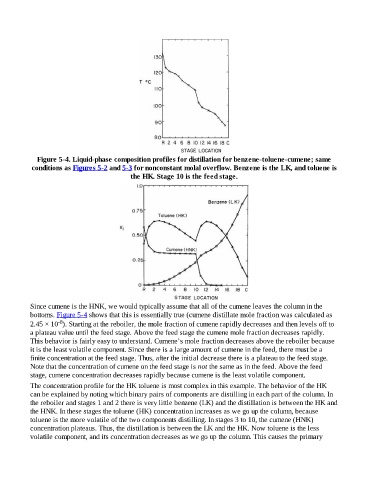
Figure 5-4. Liquid-phase composition profiles for distillation for benzene-toluene-cumene; same
                     conditions as Figures 5-2 and 5-3 for nonconstant molal overflow. Benzene is the LK, and toluene is
                                                           the HK. Stage 10 is the feed stage.


                    Since cumene is the HNK, we would typically assume that all of the cumene leaves the column in the
                    bottoms. Figure 5-4 shows that this is essentially true (cumene distillate mole fraction was calculated as
                               -8
                    2.45 × 10 ). Starting at the reboiler, the mole fraction of cumene rapidly decreases and then levels off to
                    a plateau value until the feed stage. Above the feed stage the cumene mole fraction decreases rapidly.
                    This behavior is fairly easy to understand. Cumene’s mole fraction decreases above the reboiler because
                    it is the least volatile component. Since there is a large amount of cumene in the feed, there must be a

                    finite concentration at the feed stage. Thus, after the initial decrease there is a plateau to the feed stage.
                    Note that the concentration of cumene on the feed stage is not the same as in the feed. Above the feed
                    stage, cumene concentration decreases rapidly because cumene is the least volatile component.
                    The concentration profile for the HK toluene is most complex in this example. The behavior of the HK
                    can be explained by noting which binary pairs of components are distilling in each part of the column. In

                    the reboiler and stages 1 and 2 there is very little benzene (LK) and the distillation is between the HK and
                    the HNK. In these stages the toluene (HK) concentration increases as we go up the column, because
                    toluene is the more volatile of the two components distilling. In stages 3 to 10, the cumene (HNK)
                    concentration plateaus. Thus, the distillation is between the LK and the HK. Now toluene is the less
                    volatile component, and its concentration decreases as we go up the column. This causes the primary

