


Page 234 - Separation process engineering
P. 234
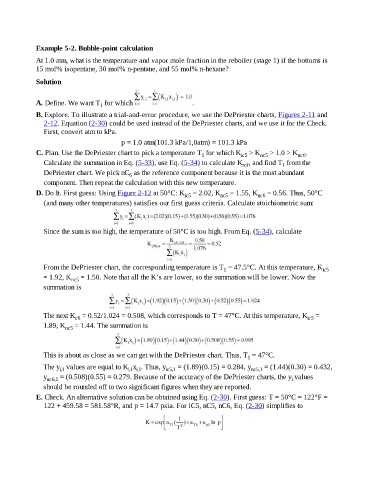
Example 5-2. Bubble-point calculation

                      At 1.0 atm, what is the temperature and vapor mole fraction in the reboiler (stage 1) if the bottoms is
                      15 mol% isopentane, 30 mol% n-pentane, and 55 mol% n-hexane?

                      Solution


                      A. Define. We want T  for which                              .
                                               1
                      B. Explore. To illustrate a trial-and-error procedure, we use the DePriester charts, Figures 2-11 and
                         2-12. Equation (2-30) could be used instead of the DePriester charts, and we use it for the Check.
                         First, convert atm to kPa.

                                                        p = 1.0 atm(101.3 kPa/1,0atm) = 101.3 kPa
                      C. Plan. Use the DePriester chart to pick a temperature T  for which K  > K                 > 1.0 > K     .
                                                                                       1              ic5     nc5            nc6
                         Calculate the summation in Eq. (5-33), use Eq. (5-34) to calculate K , and find T  from the
                                                                                                                       1
                                                                                                       ref
                         DePriester chart. We pick nC  as the reference component because it is the most abundant
                                                           6
                         component. Then repeat the calculation with this new temperature.
                      D. Do It. First guess: Using Figure 2-12 at 50°C: K  = 2.02, K          nc5  = 1.55, K nc6  = 0.56. Thus, 50°C
                                                                                ic5
                         (and many other temperatures) satisfies our first guess criteria. Calculate stoichiometric sum:


                         Since the sum is too high, the temperature of 50°C is too high. From Eq. (5-34), calculate


                         From the DePriester chart, the corresponding temperature is T  = 47.5°C. At this temperature, K              ic5
                                                                                                1
                         = 1.92, K  nc5  = 1.50. Note that all the K’s are lower, so the summation will be lower. Now the
                         summation is


                         The next K  = 0.52/1.024 = 0.508, which corresponds to T = 47°C. At this temperature, K  =
                                                                                                                                ic5
                                      c6
                         1.89, K  nc5  = 1.44. The summation is


                         This is about as close as we can get with the DePriester chart. Thus, T  = 47°C.
                                                                                                         1
                         The y  values are equal to K x . Thus, y        ic5,1  = (1.89)(0.15) = 0.284, y nc5,1  = (1.44)(0.30) = 0.432,
                                i,1
                                                          i,1 i,1
                         y      = (0.508)(0.55) = 0.279. Because of the accuracy of the DePriester charts, the y values
                          nc6,1                                                                                           i
                         should be rounded off to two significant figures when they are reported.
                      E. Check. An alternative solution can be obtained using Eq. (2-30). First guess: T = 50°C = 122°F =
                         122 + 459.58 = 581.58°R, and p = 14.7 psia. For iC5, nC5, nC6, Eq. (2-30) simplifies to

