


Page 259 - Separation process engineering
P. 259
(6-33)

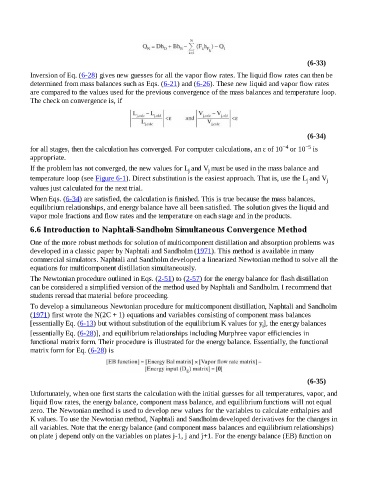
                    Inversion of Eq. (6-28) gives new guesses for all the vapor flow rates. The liquid flow rates can then be
                    determined from mass balances such as Eqs. (6-21) and (6-26). These new liquid and vapor flow rates
                    are compared to the values used for the previous convergence of the mass balances and temperature loop.
                    The check on convergence is, if


                                                                                                                                (6-34)

                                                                                                                       −4
                                                                                                                                −5
                    for all stages, then the calculation has converged. For computer calculations, an ε of 10  or 10  is
                    appropriate.
                    If the problem has not converged, the new values for L and V must be used in the mass balance and
                                                                                  j
                                                                                          j
                    temperature loop (see Figure 6-1). Direct substitution is the easiest approach. That is, use the L and V            j
                                                                                                                                j
                    values just calculated for the next trial.

                    When Eqs. (6-34) are satisfied, the calculation is finished. This is true because the mass balances,
                    equilibrium relationships, and energy balance have all been satisfied. The solution gives the liquid and
                    vapor mole fractions and flow rates and the temperature on each stage and in the products.

                    6.6 Introduction to Naphtali-Sandholm Simultaneous Convergence Method

                    One of the more robust methods for solution of multicomponent distillation and absorption problems was
                    developed in a classic paper by Naphtali and Sandholm (1971). This method is available in many

                    commercial simulators. Naphtali and Sandholm developed a linearized Newtonian method to solve all the
                    equations for multicomponent distillation simultaneously.
                    The Newtonian procedure outlined in Eqs. (2-51) to (2-57) for the energy balance for flash distillation
                    can be considered a simplified version of the method used by Naphtali and Sandholm. I recommend that
                    students reread that material before proceeding.

                    To develop a simultaneous Newtonian procedure for multicomponent distillation, Naphtali and Sandholm
                    (1971) first wrote the N(2C + 1) equations and variables consisting of component mass balances
                    [essentially Eq. (6-13) but without substitution of the equilibrium K values for y], the energy balances
                                                                                                               i
                    [essentially Eq. (6-28)], and equilibrium relationships including Murphree vapor efficiencies in
                    functional matrix form. Their procedure is illustrated for the energy balance. Essentially, the functional
                    matrix form for Eq. (6-28) is


                                                                                                                                (6-35)

                    Unfortunately, when one first starts the calculation with the initial guesses for all temperatures, vapor, and
                    liquid flow rates, the energy balance, component mass balance, and equilibrium functions will not equal
                    zero. The Newtonian method is used to develop new values for the variables to calculate enthalpies and

                    K values. To use the Newtonian method, Naphtali and Sandholm developed derivatives for the changes in
                    all variables. Note that the energy balance (and component mass balances and equilibrium relationships)
                    on plate j depend only on the variables on plates j-1, j and j+1. For the energy balance (EB) function on

