


Page 260 - Separation process engineering
P. 260
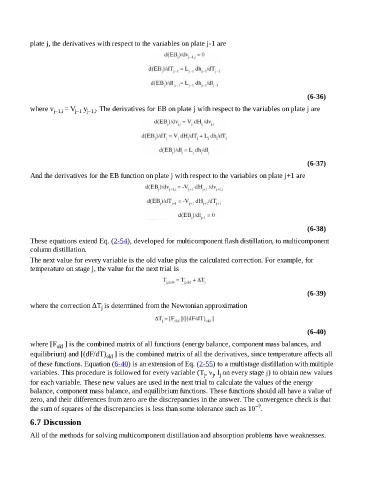
plate j, the derivatives with respect to the variables on plate j-1 are


                                                                                                                                (6-36)

                    where v  j–1,i  = V  y    . The derivatives for EB on plate j with respect to the variables on plate j are
                                      j–1 j–1,i


                                                                                                                                (6-37)

                    And the derivatives for the EB function on plate j with respect to the variables on plate j+1 are


                                                                                                                                (6-38)

                    These equations extend Eq. (2-54), developed for multicomponent flash distillation, to multicomponent
                    column distillation.

                    The next value for every variable is the old value plus the calculated correction. For example, for
                    temperature on stage j, the value for the next trial is


                                                                                                                                (6-39)

                    where the correction ΔT is determined from the Newtonian approximation
                                                j


                                                                                                                                (6-40)

                    where [F  ] is the combined matrix of all functions (energy balance, component mass balances, and
                              old
                    equilibrium) and [(dF/dT)  ] is the combined matrix of all the derivatives, since temperature affects all
                                                  old
                    of these functions. Equation (6-40) is an extension of Eq. (2-55) to a multistage distillation with multiple
                    variables. This procedure is followed for every variable (T, v , l  on every stage j) to obtain new values
                                                                                        j
                                                                                           j j
                    for each variable. These new values are used in the next trial to calculate the values of the energy
                    balance, component mass balance, and equilibrium functions. These functions should all have a value of
                    zero, and their differences from zero are the discrepancies in the answer. The convergence check is that
                                                                                                            −7
                    the sum of squares of the discrepancies is less than some tolerance such as 10 .
                    6.7 Discussion

                    All of the methods for solving multicomponent distillation and absorption problems have weaknesses.

